Home › Services › Symptoms › Flickering Lights
Some flickering is ordinary physics and always will be. Some flickering is a connection quietly failing inside a wall, and that kind gets worse on its own. The two are told apart by pattern rather than by intensity: what triggers it, how much of the house it touches, and whether it has changed over months. Describe the pattern and get connected with an independent, TDLR-licensed electrician working in the county.
A motor at rest draws far more current in the instant it starts than it does once it is turning — several times as much, for a fraction of a second. That surge pulls the voltage down slightly across everything on the service while it lasts, and the lights show it. An air conditioning condenser, a well pump, a pool pump, a shop compressor and a large table saw all do this by design.
A benign version of this has a recognizable shape. It is brief, it coincides with something you can hear starting, it dips the whole house rather than one room, it recovers immediately, and it has behaved that way since the house was new. Long rural service drops in the west and south of the county make the dip a little more visible than a short suburban lateral does, and that is still normal.
What matters is change. A dip that has grown deeper, lasts longer than it used to, or now comes with a buzz or a hum is worth reporting even though the trigger is familiar. The trigger has not changed; something between the transformer and the lamp has.
Three patterns take a flicker out of the ordinary category. It follows no appliance at all and appears at random. It affects one circuit while the rest of the house stays steady. Or it has been slowly worsening over months. Any of the three usually points at the same physical thing: a termination that has loosened, corroded or was never properly made.
The candidates are unglamorous and specific — a receptacle wired by pushing conductors into the back rather than under the screws, a breaker not fully seated on the bus, a screw that was never brought up to torque, a neutral poorly landed on the bar, a splice in an attic junction box. In a house built between 1965 and the mid-1970s, an aluminum-to-copper joint belongs on the list as well. What CPSC accepts as a repair →
These faults are progressive, and that is the whole argument for not living with them. A poor connection has higher resistance, current through resistance makes heat, heat expands and relaxes the joint, and the resistance rises again. Nothing about that loop reverses on its own. The flicker is the early, cheap, visible stage of a process whose later stages are a warm faceplate and a smell.
Something You Can Check Yourself
Spend one evening writing down three things each time it happens: which lights flickered, which did not, and what was switching on at that moment. If the same room is always involved, the fault is local to that circuit. If the whole house dips together, it is at the service or the panel. That distinction alone changes where a search begins.
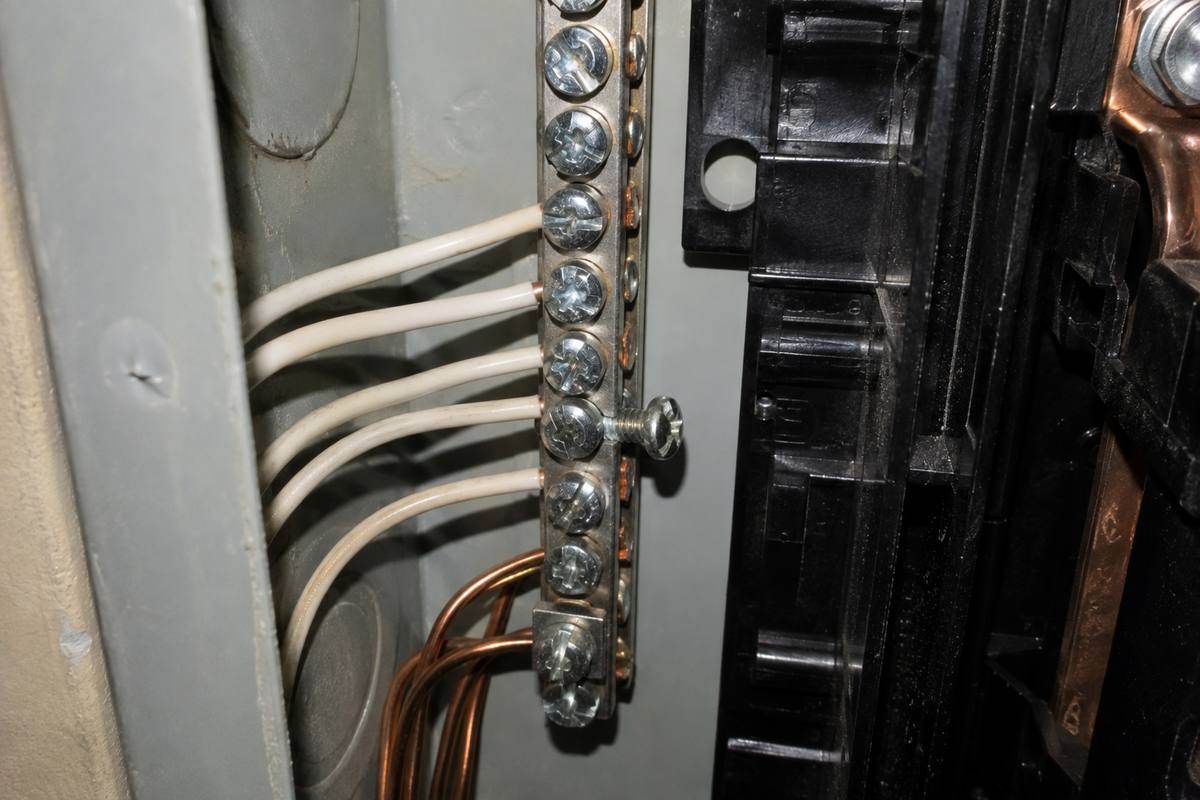
Most connection faults are a nuisance first and a hazard later. One is a hazard immediately, and it has a symptom nothing else imitates: lights on one part of the house going brighter at the same moment lights on another part go dimmer. If that describes what you are seeing, stop reading and make the call.
Here is why it happens. The neutral is the reference point that holds each of the two hot legs at 120 volts. Let that connection fail — at the neutral bar, at the meter enclosure, in the service conductors, or on the utility side — and the two halves of the house stop being independent. They end up in series across the full 240 volts, dividing it between them according to how much load each is carrying. The lightly loaded half floats up well above 120 volts. The heavily loaded half sags below it. Turning something on in one room then changes the voltage in another, which is exactly the seesaw people describe.
The damage is not hypothetical. Electronics, LED drivers, appliance control boards and anything with a power supply sit on the high side taking overvoltage for as long as the condition lasts, and they fail in batches. Motors on the low side try to start against a sagging supply and overheat. A whole-home surge device is not designed to save you from a sustained overvoltage of this kind. This is a same-day call, and if the trigger was a storm restoration, the sequencing is worth reading: partial power after an outage →
Before assuming a wiring fault, rule out the boring explanation — and in Fort Bend County it is a likely one, because 61.5% of the housing stock was finished since 2000 according to the Census Bureau’s American Community Survey (2020–2024 five-year estimates). Those houses have sound, modern wiring and have almost all had their lamps swapped for LEDs at some point.
An LED lamp draws a small fraction of the current the incandescent bulb it replaced did. A dimmer designed for that older resistive load may never see enough current to regulate cleanly, which shows up as flicker, a buzz, a narrow usable range or lamps that glow faintly when switched off. Mixing brands on one switch makes it worse, because each driver responds differently to a chopped waveform. A lamp that is simply not dimmable will flicker on any dimmer at all. And a smart switch installed where the box has no neutral conductor can produce the same complaint for a third reason entirely.
None of that is a fault in the house. It is a mismatch between three components, and it is resolved at the switch box and the lamp rather than in the walls. Rule it out first: it is the cheapest answer on this page. Switching, dimming and what the box has to contain →
On its own, usually not — that is motor inrush, and a brief dip that coincides with a known start and recovers immediately is ordinary. What matters is change. A dip that has grown deeper or longer, or now comes with a buzz, is worth reporting even though the trigger is familiar.
It heats itself. Higher resistance makes heat, heat expands and relaxes the joint, resistance rises again. That loop does not reverse, which is why a flicker that has been worsening for months deserves attention before it becomes a smell.
That is a failing or open neutral and it is urgent. The two halves of the service end up dividing 240 volts between them by load, so one side runs well over 120 volts while the other sags. Electronics on the high side fail in batches. Call the same day.
Then suspect the components before the wiring. LEDs draw too little for many older dimmers to regulate, non-dimmable lamps flicker on any dimmer, and mixed brands on one switch disagree with each other. It is the cheapest thing to rule out and it is often the answer.
Which rooms, what was switching on, and whether it has changed since last year. That is enough to sort a nuisance from a warning.
Call (346) 857-1116 Request a Quote Fort Bend