Home › Services › Symptoms › Partial Power After an Outage
The lights are on down the street. Yours came back at two in the morning and something is wrong with what returned: half the house is dead, a few lamps look strangely bright while others are dull, the refrigerator hums without starting. That is one of two faults, both to do with the service rather than any circuit — and out here it is as often the utility’s side of the meter as yours. Knowing which decides who you call first.
Restoration work is not gentle. Crews re-energize feeders, reclosers cycle, spans are cut and rejoined, and a service that spent a night whipping around in wind and rain comes back up under load. A connection already weakened by twenty years of thermal cycling often chooses that moment to let go — and nothing catches it during restoration, because from the utility’s side the house is drawing current again.
What arrives is partial power. The two candidates are a lost hot leg and an open neutral. Neither is a circuit fault, so no amount of walking the panel legend explains it, and either can occur at the transformer, along the span, at the weatherhead, in the meter enclosure or at the terminations inside the service equipment. This page exists separately from the everyday version of half a house going dark because of the timing: when a storm restoration is the trigger, the odds shift toward the utility side, and the first phone call shifts with them.
Roughly half the 120-volt circuits are simply dead. The half that still works looks completely normal — correct brightness, no wandering. Everything at 240 volts stops together: range, dryer, water heater, condenser, well pump. It is inconvenient and it needs fixing, but nothing is being actively damaged while you sort it out.
Brightness moves in opposite directions between rooms and changes when something switches on elsewhere. Motors hum and will not start. Electronics reboot, buzz or die. This is the destructive one, and the seesawing brightness is what separates it from the tidy version above.
Something You Can Check Yourself
Compare two rooms on opposite sides of the house, then have someone switch on a heavy load — a hair dryer, a kettle — in one of them while you watch the lamps in the other. If lights in the second room visibly brighten as load is added in the first, treat that as an open neutral and stop using the house’s electronics. No tools, no panel, thirty seconds.
The neutral is the reference that holds each hot leg at 120 volts against it. Break it and the two halves of the house stop being independent: they sit in series across the full 240 volts and divide it in proportion to their loads. The lightly loaded half rises well above 120 volts, the heavily loaded half falls below it, and every time something switches on the split moves.
The consequences compound. Anything with a power supply on the high side — televisions, computers, network gear, LED drivers, appliance control boards, a modern range or washer — runs on sustained overvoltage and fails, often several items in one evening. Motors on the low side stall against a sagging supply and overheat doing it. A whole-home surge device is built for transients measured in microseconds and will not protect anything from hours of sustained overvoltage.
So the instruction is short: unplug what you can reach, stop trying to start motors, and treat this as a same-day call rather than a Monday one. Reducing load repairs nothing, but it takes equipment out of the line of fire.
Nobody writes this part down, and it is the part that saves a day. Gather three facts before dialing.
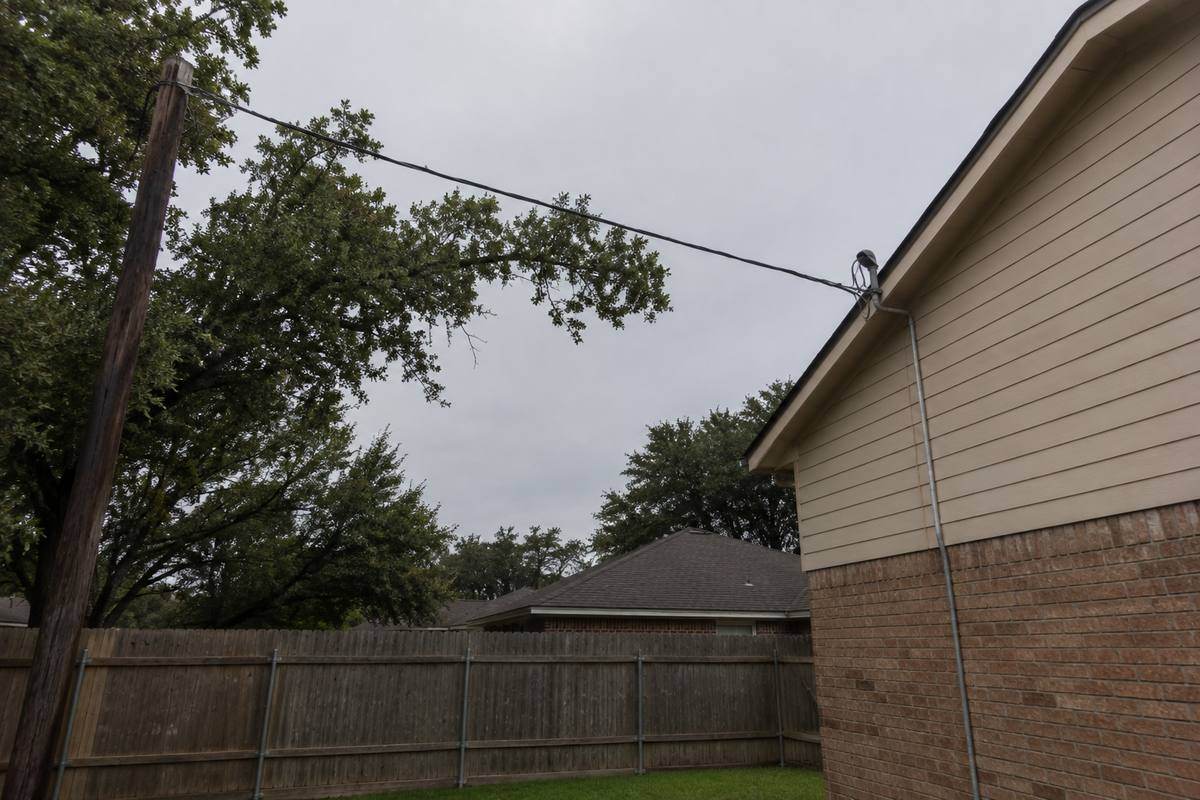
Are the neighbors affected? Knock on two doors. A neighbor with the same complaint moves the problem upstream immediately. Was the outage area-wide? Check CenterPoint’s outage map and whether crews are still working nearby; a house that came back partially during a broad restoration is a different story from one that failed alone on a clear evening. Is anything visible outside? A limb resting on the span, a drop hanging lower than it did, a conductor separated at the pole or a leaning mast are all reportable — observed from the ground, at a distance, and never near a downed line.
Evidence pointing upstream means report it to CenterPoint first. This is the utility whichever company bills you: its tariff states residential meters shall be company-owned and that it maintains the facilities at the point of delivery regardless of which retail provider sells the energy, and it lists Fort Bend among the twelve counties in its certificated service area. Evidence confined to your property — neighbors fine, area restored, nothing visible outside — points at the service equipment, and that is a licensed electrician’s work.
The awkward truth here is that the fault often sits precisely where responsibility changes hands. Broadly, the span from the pole to the attachment point is the utility’s, while the mast, weatherhead, service entrance conductors and meter base on the building belong to the property owner — with the meter itself company-owned. Storm damage does not respect that line: a branch dragging on a span pulls on the attachment, and the attachment is bolted to a mast on somebody’s roof.
Two practical consequences. A damaged mast or meter base usually has to be put right by a licensed electrician before the utility will reconnect, which makes the order of calls a scheduling matter rather than a formality. And the boundary is set by the utility’s tariff and service requirements rather than by common sense, so ask CenterPoint where the line falls at your address.
This is more a west- and south-county problem than a subdivision one. Long overhead drops across acreage in Needville, Simonton, Beasley, Fairchilds and the unincorporated county carry more exposed span, more tree contact and more distance from the transformer than a short suburban lateral. It is also the honest argument for standby power where a well and a septic system mean an outage takes the water too.
Either side, which is why evidence comes before the phone call. Neighbors affected, or crews still working nearby, points upstream to CenterPoint. Every other house normal and only yours strange points at the service equipment on the property. On a long rural drop the utility side is a common answer, not a deflection.
That is an open or failing neutral, the urgent version. The two halves of the house divide 240 volts between them by load, so one side sits well above 120 volts. Anything with a power supply on the high side is being overstressed for as long as it lasts.
Yes, if brightness is seesawing. Unplug computers, televisions, network gear and anything with a control board, and stop trying to start motors that are humming. It repairs nothing but it removes equipment from the line of fire.
It is split, and worth confirming. Broadly the span to the attachment is the utility’s and the mast, weatherhead and service entrance are the owner’s, with the meter company-owned. Because a storm hits exactly that junction, ask CenterPoint where the line falls at your address.
Whether the street is normal, whether any lights are unusually bright, and whether the big appliances are dead. Three answers decide which number to dial.
Call (346) 857-1116 Request a Quote Fort Bend