Home › Services › Aluminum Wiring Remediation
Between 1965 and the mid-1970s, aluminum was used for branch-circuit wiring in new homes, in additions and in rewired circuits, and the U.S. Consumer Product Safety Commission has published both what goes wrong with it and which repairs it accepts as permanent. That window covers a small minority of the housing in this county and a specific handful of places within it. Give the year the house was built and get connected with an independent, TDLR-licensed electrician working in Fort Bend County.
CPSC Publication 516 is specific about the dates: aluminum branch-circuit wiring was installed between 1965 and the mid-1970s, in new homes, in additions and in circuits that were rewired during that period, and homes built before 1965 are unlikely to have it. That is roughly a ten-year window, and a house on either side of it is very probably not part of this conversation at all.
Set that against Fort Bend County. The Census Bureau’s American Community Survey (2020–2024 five-year estimates) puts the median year built at 2005, with 61.5% of the stock finished since 2000 and only 4.1% predating 1970. The 1970–1979 decade adds another 8.4%, and only the front half of it falls inside the window at all. In a county of 305,633 housing units, the honest summary is that this page applies to a small minority of readers — and that for the ones it does apply to, it matters a great deal.
One distinction before going further. This page is about branch-circuit wiring — the smaller conductors feeding receptacles, switches and lights. Larger aluminum conductors used for service-entrance cable and for feeders are a separate matter with their own accepted practice, and finding aluminum at the service or on a dryer feeder is not the same finding at all.
One Number Decides Whether This Page Applies to You
Find the year the house was built before doing anything else. The Fort Bend Central Appraisal District record for the property carries it, a closing packet or an appraisal carries it, and a listing history usually does. If the answer is 1978, 1994 or 2013, the CPSC window does not cover the house and the question is effectively closed. If the answer is 1968, 1971 or 1974, keep reading — and note that the year describes the original construction, so an addition or a rewire done in that window can put the wiring in a house whose build year sits outside it.
Being geographically honest about this matters, because scaring the wrong 190,000 households would be both wrong and useless. The parts of Fort Bend County whose housing was going up inside or near the CPSC window are a short list.
Richmond’s historic core — the county seat since December 1837 and the oldest built environment here, though much of its oldest fabric predates the window entirely. Stafford, incorporated 1956, whose stock spans the era. The 1970s ring in Missouri City: Quail Valley began in 1969 and built out mostly through the 1970s, with Hunters Glen, Briargate, Meadowcreek and Fondren Park also 1970s. The rail-town core of Rosenberg, incorporated 1902 and now wrapped in new construction. Meadows Place, whose housing is essentially 1970s, finished before the city incorporated on November 14, 1983. And the small west-county towns and Needville, where the older fabric is scattered rather than concentrated.
Fulshear is the clearest case: its housing is essentially all post-2010, so there is no aluminum branch-circuit question there, no Federal Pacific question, and modern ground-fault and arc-fault protection throughout. The same holds for Cross Creek Ranch and for Harvest Green. Cinco Ranch began development in the 1980s and opened in 1991, so even its earliest phases sit fifteen years past the window. Anything in the 2010s west county — and the 2010s alone added 92,607 homes to this county — is outside it by decades. If your house is in one of those places, this page is not your page; the load-growth questions are.
Note carefully what is being claimed here and what is not. The build years line up in the places named above. Nothing on this page asserts how many houses in any of them actually contain aluminum branch-circuit wiring — no source supports that, and a site that guessed at it would be inventing a number to sell against.
Two places are worth looking, and one is worth leaving alone. The first is the cable itself, where it is visible. In an attic, a garage or a utility space, cable sheathing carries printed markings along its length, and the conductor material is part of that marking — look for “AL” or “ALUMINUM” printed on the jacket. In a house of that vintage the attic run above the top plates is often the easiest place to find legible printing. The second is the panel: with the outer door open, the conductor material of the circuits landing on breakers is sometimes visible without removing anything, and an aluminum conductor has an obviously different color from copper.
Where to stop: do not pull receptacles and switches out of their boxes to look. The hazard on these circuits lives at exactly those terminations, disturbing an aged aluminum termination is a good way to make a marginal one worse, and doing it on live circuits is how people get hurt. Confirmation is a licensed electrician’s job, and it is a fast one.
Symptoms that should move the timeline forward: warm cover plates, devices hot to the touch, flickering not tied to a large appliance starting, the smell of hot plastic, arcing sounds. A burning smell at an outlet is the one where the first move is the breaker, not the phone. Absence of symptoms proves nothing, which is the difficult part — the mechanism below runs a long way before it announces itself.
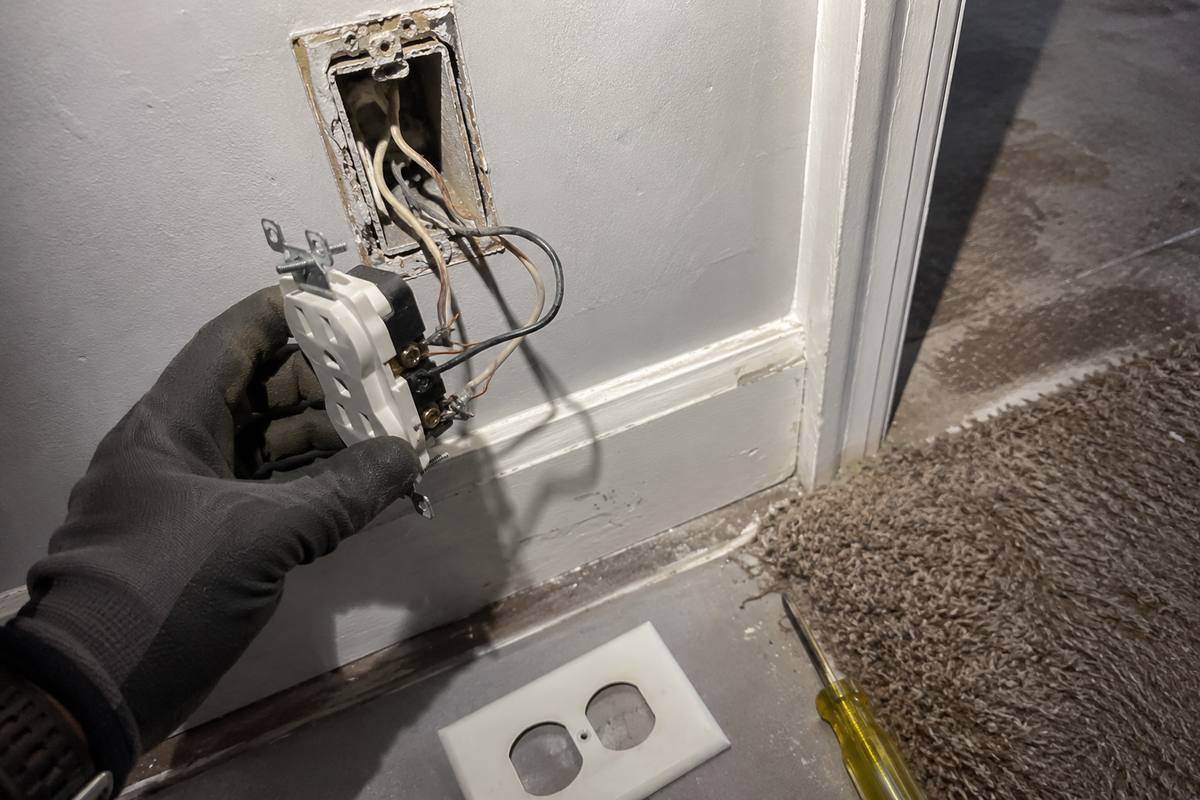
Aluminum conducts electricity perfectly well. The wire in the wall is not the problem, and nothing about this is a slow decay of the cable along its length. The problem is what happens where the conductor is clamped to something else.
CPSC describes it directly: oxidation and creep at terminations raise resistance, and “that increased resistance causes overheating, sometimes at hazardous levels, when current is flowing in the circuit.” Unpacked, that is two effects working together. Aluminum forms an oxide layer, and that oxide is a poorer conductor than the metal beneath it. Aluminum also creeps — it deforms slowly under the sustained pressure of a terminal screw, and it expands and contracts with heating more than copper does, so a connection that was tight when it was made gradually loosens itself. A loose, oxidized connection has resistance. Resistance under load makes heat. Heat accelerates both the oxidation and the creep, and the loop tightens on itself.
Two consequences follow, and both shape how remediation is scoped. First, the failure is local to a termination — a single receptacle, a single switch, a single splice in a junction box — not general to the circuit. Second, a house of this era has hundreds of terminations, and each one is an independent instance of the same process running at its own rate. That is the whole reason the accepted repairs work the way they do.
This is the most useful thing on the page, and it is worth reading twice, because the market does not always present it accurately.
Replacing the aluminum branch-circuit cable with copper cable removes the mechanism entirely rather than managing it. It is the most disruptive option and the most expensive, and it is the one that leaves nothing behind to revisit. Scope and price look like a rewire, which in Angi’s Houston figures runs $2 to $4 per square foot — roughly $3,000–$6,000 at 1,500 square feet, $4,000–$8,000 at 2,000 and $6,000–$12,000 at 3,000. Ranges, not quotes.
A special metal sleeve is crimped over the aluminum conductor and a short copper pigtail with a purpose-built tool, forming a cold weld. The copper end then lands on the device. It is a proper permanent repair by CPSC’s account, and its practical constraint is access: the tooling and training are restricted, so availability is a real scheduling question rather than a formality.
A set-screw connector that joins the aluminum conductor to a copper pigtail inside its own body, with the screws torqued to specification. It needs no restricted tooling, which makes it far more available in practice, and CPSC lists it among the accepted permanent repairs. Box fill has to be considered, since the connector takes room inside an already small 1970s device box.
And now the part that is worth stating in CPSC’s own terms. CPSC does not accept twist-on connectors or CO/ALR devices as permanent repairs. In CPSC-sponsored testing, “substantial numbers of these connectors overheated severely”, and CO/ALR devices “have failed in laboratory tests when connected to aluminum wire typical of that installed in existing homes”. Both are allowed only as an emergency, temporary repair. That matters because both are cheap, both are widely available, and both are sometimes offered as a solution to this problem. A quote built on either one is not a quote for a permanent repair, and the honest thing to do is ask which of the three accepted methods is being proposed and get the answer in writing.
Because the hazard is termination-by-termination, remediation is scoped termination-by-termination. Doing the kitchen because that is where the warm plate was, or doing the receptacles but not the switches, or doing the accessible boxes but skipping the ones behind furniture, produces a house that has been worked on rather than a house that has been repaired. Every termination left untreated is still running the same oxidation-and-creep process at its own pace, and none of them are required to warn anybody first.
A proper scope is every accessible termination on the aluminum branch circuits — receptacles, switches, light fixtures, junction boxes, appliance connections, and the landings at the panel — treated with one of the three accepted methods. Where something is genuinely inaccessible, that should be identified and written down rather than passed over silently, so the owner knows what remains.
Two related points for a house of this age. If the panel label reads Federal Pacific or Zinsco, that is a separate question with its own answer — the panel upgrade page sets out what CPSC did and did not conclude about Stab-Lok, and why the evidence behind Zinsco is thinner. And a mid-1970s house predates most modern protection: ground-fault protection reached bathrooms in 1975 and garages in 1978, and arc-fault protection was not mandatory for bedrooms until January 1, 2002. None of it is required retroactively, and all of it is worth knowing before deciding how far to go.
Finally, who checks the work. Meadows Place permits locally with BBG Consulting as building official and requires homeowners as well as contractors to register, on the 2014 NEC; Missouri City is on the 2023 NEC with contractor registration. In unincorporated county there is no electrical permit and no inspection at all, which leaves a private electrical inspection as the only qualified review the work gets. Permits, city by city →
Start with the build year, which settles most cases by itself: CPSC puts aluminum branch-circuit wiring in homes, additions and rewired circuits from 1965 to the mid-1970s, and says homes built before 1965 are unlikely to have it. If the year falls outside the window, the question is largely closed. If it falls inside, look for “AL” or “ALUMINUM” printed on visible cable sheathing in an attic or garage — and stop there. Do not pull devices out of boxes to check; that is where the hazard lives and it is a licensed electrician’s job.
Three: complete replacement with copper cable, the COPALUM crimp method, and the AlumiConn connector. CPSC does not accept twist-on connectors or CO/ALR devices as permanent repairs — in CPSC-sponsored testing “substantial numbers of these connectors overheated severely”, and CO/ALR devices “have failed in laboratory tests when connected to aluminum wire typical of that installed in existing homes”. Both are permitted only as an emergency, temporary repair. Ask which method a quote is based on before signing it.
County-wide, no. Only 4.1% of Fort Bend County housing predates 1970 and the median year built is 2005, so the window covers a small minority of the stock. Where the dates do line up: Richmond’s historic core, Stafford, the 1970s ring in Missouri City including Quail Valley, the Rosenberg rail-town core, Meadows Place, and the small rural towns. Where they emphatically do not: Fulshear, Cross Creek Ranch, Harvest Green and anything built in the 2010s west county.
No, and it is worth being blunt about why. The hazard is at terminations, a house of that era has hundreds of them, and each one runs the same oxidation-and-creep process independently. Fixing the ones that have already announced themselves leaves every one that has not, and nothing in the mechanism requires a warning first. A remediation covers every accessible termination on the aluminum circuits using an accepted method; anything less should be described as a partial measure, not as a fix.
The year the house was built, whether anything visible is marked “AL”, and what the panel door reads. That is enough to get connected with an independent TDLR-licensed electrician working in Fort Bend County.
Call (346) 857-1116 Request a Quote Fort Bend