Home › Services › Surge Protection
The device that fails after a storm is rarely the one that took a lightning hit. It is the one that had absorbed small transients for years and gave out during a night of the power going off and on. Surge protection at the service equipment is the cheap end of the electrical trade and one of the few genuinely preventive parts of it. Get connected with an independent, TDLR-licensed electrician working in the county.
The picture almost everybody carries is a strike hitting a house and killing a television. That happens, and it is not what surge protection solves: a direct strike carries energy no service-entrance device is built to absorb, and any product promising otherwise is overselling.
The realistic damage model is cumulative. Transients arrive in quantity at modest energy — switching on the distribution system, a nearby strike coupling into a line rather than hitting it, reclosers doing their job during a storm, and, the part people miss, motor loads inside the house. A compressor, a pool pump, a well pump and a refrigerator each generate one every time they stop. Electronics take those quietly, degrade, and fail on a day that gets blamed on the weather.
Storm-season power cycling is the pattern worth naming here. An evening where the lights drop and come back four times is four restorations, each an event on the service conductors and each a start-up inrush for everything that had been running. That is a harder night for electronics than one clean six-hour outage.
None of which says the grid is deteriorating — the recent trend runs the other way. CenterPoint reported roughly a 45% reduction in customer outage minutes in the first half of 2025 against 2024 and about 33% fewer vegetation-related outages; the PUCT approved a $2.7 billion systemwide resiliency plan covering 2026–2028 in August 2025; 99% of customers kept power through the January 2026 winter storm. Fewer and shorter interruptions is real improvement. It is not zero transients on a Gulf Coast distribution system in August.
The Type 1 and Type 2 labels describe where a device is permitted to connect, not how good it is. Reading them as good and better is the common misunderstanding here.
Listed for connection on the line side of the service disconnect, at or near the meter, ahead of everything else — the earliest interception available on the property. That location involves utility-owned equipment at the point of delivery, so the position is coordinated rather than assumed; the panel and service page covers who owns what there.
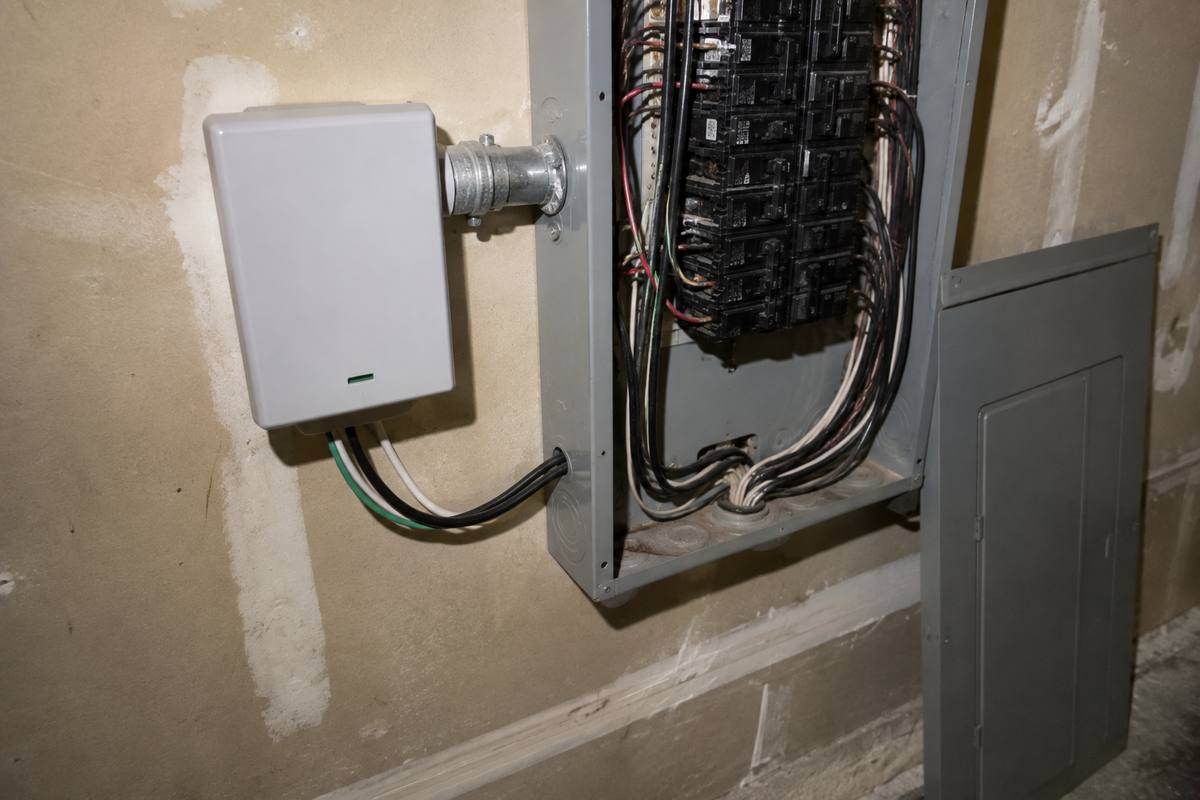
Connected on the load side, normally right at the load center on a short conduit nipple with the leads kept short and straight — lead length matters more to performance than most spec sheets admit. This is the standard residential position, protecting every branch circuit fed from that panel.
A Type 1 ahead of a Type 2 is a staged arrangement, not a duplicate purchase. Where a house has a subpanel in a shop or detached garage, the same logic repeats at that panel — protection at the main service does not extend usefully down a long feeder.
A device at the service equipment reduces what enters from outside. Two things it cannot do: address a transient generated inside the house downstream of it, and stop every last joule reaching a branch circuit. Point-of-use protection sits where that matters — at the equipment worth protecting.
The layered picture is the honest one. The service-entrance device does the heavy work on anything arriving from the utility side; the local device at the television, the office equipment or the well control panel handles what gets past it and what the house generates itself. Buying only the second layer is the common mistake, buying only the first the less common one, and both leave a gap.
Two practical notes. A surge device is a consumable — it absorbs energy and degrades, which is why they carry status indicators, and an indicator nobody looks at is doing half its job. And protection follows the wire: a coaxial or data line entering the house is a path in that a device on the power conductors does not cover.
Geography changes this case more than people expect. Fort Bend County covers 861.72 square miles, much of it rural — acreage west of Fulshear, farmland around Needville and Beasley, small towns on the old rail lines. Distribution out there is largely overhead, spans between poles are long, and the drop from the last pole to the house can cross a good deal of yard.
Three consequences follow. A long overhead run presents more conductor length for a nearby strike to couple into, and more exposure to the vegetation contact that causes switching in the first place. Restoration on a rural circuit tends to involve more switching operations than in a dense subdivision — more of the cycling described above. And a rural property depends on electronics in ways a city one does not: a well control panel and an aerobic septic control and alarm are not conveniences, and a dead control board is a different kind of problem from a dead television.
If a standby generator is in the picture, surge protection belongs in the same conversation — a transfer is itself a switching event, and the generator’s controller is electronics like anything else on the property.
National survey figures put a Type 1 device installed at roughly $250 to $800 and a Type 2 device installed at roughly $200 to $450. Those are national numbers, not a quote for an address; what moves them locally is the state of the existing service equipment, whether the panel has room and a suitable connection point, and whether anything else is happening the same visit. It is small enough to be cheaper attached to other work than booked alone.
The value case has moved for the same reason everything else on this site has. A house built to the builder’s package in 2006 now holds an inverter-driven condenser, a variable-speed pool pump, LED drivers in every ceiling, a network cabinet, appliances with control boards, possibly an EV charging unit, and on acreage a pump controller. Nearly all of it is electronics on a circuit. The load-growth story that drives panel work drives this one too — the same house has far more to lose to a transient than when it was new.
What it does not cover: a direct strike, an extended overvoltage condition, or damage that was a loose termination all along. If devices on one circuit fail repeatedly while the rest of the house is fine, a protector will not fix it — that is a fault to be traced.
No, and a product claiming to is overselling. A direct strike carries energy no service-entrance device is built to absorb. These devices address the far more common case — repeated smaller transients over the service conductors during storm season and switching, plus the ones the house makes itself every time a compressor or pump stops.
Neither — they are positions, not grades. Type 1 is listed to connect on the line side of the service disconnect, at or near the meter. Type 2 connects on the load side at the panel, protecting the branch circuits fed from it. Type 2 is the common residential position; a Type 1 ahead of it adds a stage rather than replacing one.
No — they cover different things. The panel device reduces what comes in from outside; it cannot address a transient generated downstream of it, and some energy reaches the branch circuits anyway. Point-of-use protection catches the remainder at the equipment worth protecting.
In unincorporated Fort Bend County there is no county electrical permit and no county electrical inspection on residential work, so nothing external requires or checks it. Inside a city, the adopted NEC edition governs and those editions differ widely across this county — confirm with the city rather than assuming. The state license requirement applies either way. Who signs off where →
Say what the panel is, whether the service is overhead, and what else is on the list. That is enough to get connected with a licensed Fort Bend County electrician.
Call (346) 857-1116 Request a Quote Fort Bend