Home › Services › EV Charger Installation
Look at the panel before you look at chargers. The hardware is the easy part and the least consequential decision in the project; what decides the price, the schedule and occasionally the feasibility is how much of the existing service is already spoken for and how far the car parks from the panel. Give the build year, the amp rating on the main breaker and where the car sits, and get connected with an independent, TDLR-licensed electrician working in Fort Bend County.
A Level 2 charger is a 240-volt appliance on a dedicated two-pole circuit, most commonly 40 or 50 amps, either hardwired or served by a receptacle depending on the unit and on what the adopted code edition requires. Described that way it sounds like a range circuit, and electrically it is not far off. The difference is duration: a range draws hard for twenty minutes, and a car draws steadily for hours. That is why an EV charging load is treated as a continuous load and counted at 125% of its rating in the calculation — a 40-amp charger is planned for as 50 amps of continuous demand.
So the first question is not which brand. It is whether the service has that much headroom left after the air conditioning, the water heater, the range, the dryer, the pool equipment and everything else the house has quietly accumulated since it was built. Two houses on identical 200-amp services can give completely different answers, and neither answer is visible from the driveway.
Something You Can Check Yourself
Open the panel door, read the amp number on the main breaker handle, then write down the amp ratings of every double-width breaker in the panel — those are the 240-volt loads, and they are the ones that matter. Air handler, condenser, water heater, range, dryer, pool pump, spa. That short list plus the square footage is most of what a licensed electrician needs to tell you over the phone whether this is a straightforward job or a service upgrade first.
A load calculation is a defined procedure, not an opinion. It totals the general lighting and receptacle load from the square footage, the fixed appliances, the largest of the heating or cooling loads, and the new continuous load at 125%, applies the demand factors the code allows, and compares the result against the service rating. On an existing house there is also a method that works from a year of actual recorded demand, which frequently shows more real headroom than the worked-from-scratch figure suggests. Which method fits is a judgment a licensed electrician makes on site.
When the calculation says no, there are more answers than “upgrade the service.” Load management devices can allow a charger to coexist with an existing service by pausing charging when the house draws hard elsewhere — the car sits there all night, so it is the one load that genuinely does not care about being interrupted. A lower-amperage charger, or one that is set to a lower current limit, often adds enough range overnight for a normal commute without touching the panel at all. And where the service genuinely is the constraint, the upgrade is the honest answer and carries a $800 to $2,000 adder in national survey data.
Physical slots are the smaller problem but they still stop jobs. A panel with no free spaces may take tandem breakers if the bus is listed for them, or may need a subpanel, or may be at the end of its useful life anyway. If the label reads Federal Pacific or Zinsco, that conversation moves earlier — the panel page sets out where each of those names actually stands.
This is the clearest load-growth story in the county, and it concentrates in the newest and highest-income parts of it. Fulshear reports a median household income of $187,035 and 90.0% owner-occupancy on the Census Bureau’s American Community Survey (2020–2024 five-year estimates). Cinco Ranch, an unincorporated CDP spanning Fort Bend and Harris, reports $161,972 and 74.2% on the same survey. Both figures sit far above the other Fort Bend places with published estimates — Missouri City at $94,390, Rosenberg at $65,668, Richmond at $50,337 — and both places are dominated by newer construction with attached garages, owner-occupied, where adding a circuit is a decision the resident can simply make.
Fulshear’s growth is the extreme case: the Census Bureau put it second-fastest-growing city in America on the Vintage 2024 estimates at +26.9%, and second again on Vintage 2025 at +21.0%, reaching 64,630 — though the city manager’s own count is 42,000 to 46,000, because the Bureau extrapolates from building permits while the city counts certificates of occupancy and live utility connections. The Bureau figure is the one quoted here. Either way, that housing is essentially all post-2010, which means modern 200-amp services, modern protection and no old-panel problem — the constraint is arithmetic, not age.
Cinco Ranch is the more layered case. Development began in the 1980s, the community opened in 1991 and the developer finished selling in 2020, so its earliest phases are a 1990s and 2000s cohort and its latest are modern. Those earliest houses predate the 2002 effective date for arc-fault protection in bedrooms — not a charger question directly, but it shapes what a licensed electrician notices with the deadfront off. It also sits in Houston’s ETJ, so no city electrical code applies.
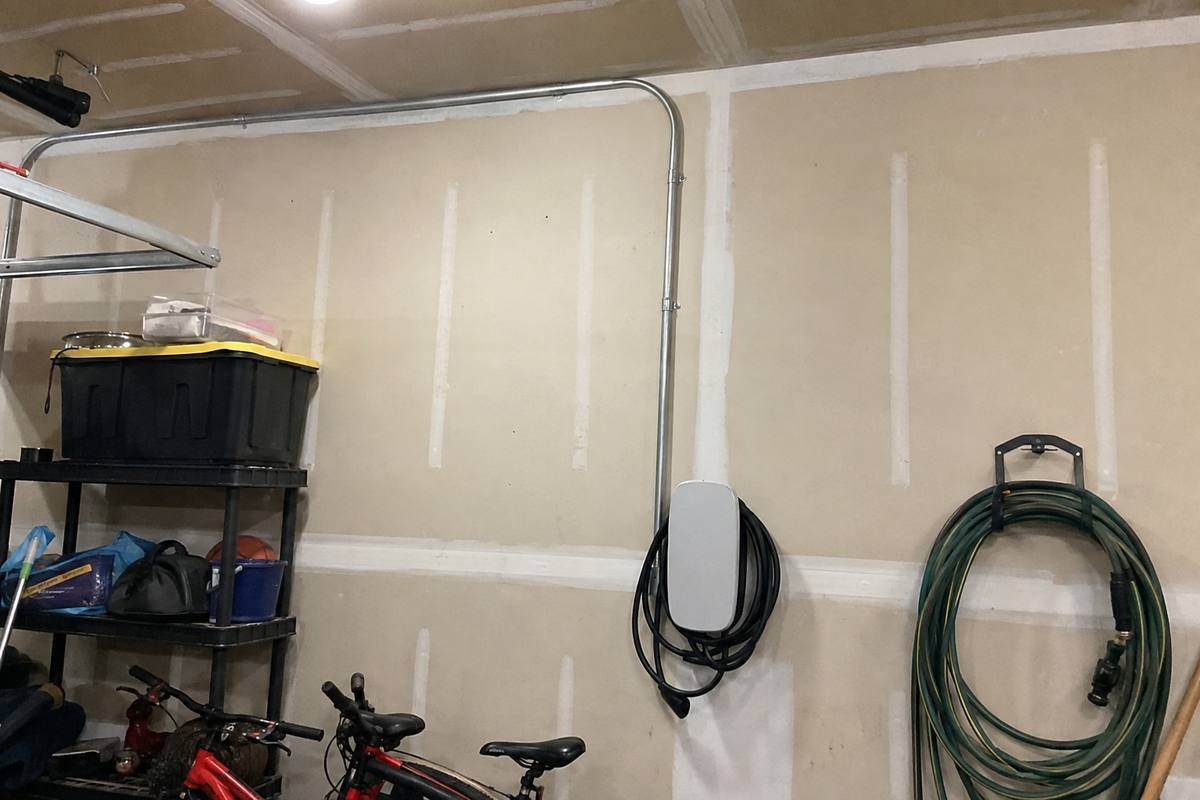
Inside a city lot the charger is twenty feet of conduit from the panel and the conversation is over. On acreage — and this county has a great deal of it — the car parks in a detached garage, a carport or a metal building at the end of a driveway measured in hundreds of feet. That is where the money goes, and it is worth understanding why.
Conductors have resistance, and resistance over distance produces voltage drop. A conductor sized correctly for 50 amps of current can still be the wrong conductor for a 250-foot run, because by the time the power arrives the voltage at the charger has sagged. Low voltage at a charger means slower charging at best and heat and equipment stress at worst. The remedy is upsizing the conductors — sometimes by one size, sometimes by several — and copper and aluminum feeder in those sizes is not cheap. The calculation is straightforward for a licensed electrician and it should be done rather than eyeballed.
Then the wire has to get there. Overhead spans are possible but usually unwelcome across a driveway; the normal answer is underground, which means a trench, a wiring method listed for the location, and a burial depth appropriate to that method. Depths differ by wiring method — direct-buried cable deepest, PVC conduit shallower, rigid metal conduit shallower still — and the exact figures come from the code edition the jurisdiction has adopted, which in Fort Bend County ranges from the 2014 NEC to the 2023 NEC depending on the city. Confirm the applicable edition rather than assuming.
Once a trench is open, running a single dedicated circuit out to it is frequently the wrong answer. A small subpanel at the garage costs more up front and delivers a great deal more: the charger, lighting, receptacles, a compressor, a freezer, a future second car. There is no reliable published figure for that adder and this page will not invent one — it depends on distance, feeder size, trenching conditions and what the building already has. The subpanel and outbuildings page covers what that installation involves in detail, including the disconnect and grounding electrode a separate structure requires.
National survey data puts Level 2 charging hardware at $300 to $1,000 and up, and the job installed at $700 to $2,000 and up. Label those clearly: national figures, published as ranges, and not a quote for your driveway. In the Houston market they read as a starting point rather than a midpoint, for the same reasons set out on the panel page.
Two adders account for most of the variation. A panel upgrade runs $800 to $2,000 where the service cannot carry the new load. A long run or new wiring runs $500 to $1,500 — which covers a difficult route through an attic or across a house, and reaches the top of the range fast once a trench and upsized conductors are involved. The detached-garage subpanel case sits outside both figures and is priced from the site, not from a table.
What is worth spending on: conduit and conductors sized generously enough that a second car or a faster unit does not mean opening the trench again, and a licensed electrician who does the load calculation properly rather than assuming. What is not worth spending on: hardware features that duplicate what the vehicle already does. Charging schedules and rate optimization live in most cars now.
Inside a city, adding a charger circuit is permitted electrical work, and which rules apply varies more here than most people expect. Missouri City enforces the 2023 NEC with contractor registration; Richmond enforces the 2023 NEC on a 2024 code family, the most current in the county; Stafford remains on the 2017; Fulshear and Meadows Place are on the 2014 NEC. That is three code cycles and nine years apart within one county line. Rosenberg’s edition is unsettled and should be confirmed with the city; Needville issues its own permits with inspections Tuesday to Friday, called in by 3pm the day before.
Outside a city, none of that applies. Fort Bend County has adopted no residential building code, issues no electrical permit and performs no electrical inspection, and its own building-codes page states that the county “has not adopted zoning ordinances and does not issue Certificates Of Occupancy.” The Fire Marshal’s Office does issue Certificates of Compliance for certain multi-family and non-residential developments under the 2021 International Fire Code effective October 1, 2023, but that instrument does not reach a house.
A city mailing address settles nothing either. Texas municipalities cannot enforce building codes or require building permits in their extraterritorial jurisdiction — Town of Lakewood Village v. Bizios, 493 S.W.3d 527 (Tex. 2016), extended to home-rule cities in Collin County v. City of McKinney, 553 S.W.3d 79 (Tex. App.—Dallas 2018) — so Cinco Ranch in Houston’s ETJ, and much of Pecan Grove, are under unincorporated-county rules whatever the envelope says. The state license does not move: Occupations Code §1305.151 bars performing or offering to perform electrical work without one, and §1305.303 makes an offense a Class C misdemeanor. Where no permit will ever be pulled, asking for the company’s license number and checking it on TDLR’s free public search is the only verification step there is. Permits, city by city →
Both, and they are different questions. A spare slot is physical room for a two-pole breaker. Spare capacity is whether the service has headroom left, after everything the house already runs, for a continuous load counted at 125% of its rating. A panel can look half empty with no capacity to spare and look completely full with plenty. Only a load calculation settles it, and on an existing house it can be run from a year of recorded demand as well as from first principles.
National survey data gives $300 to $1,000+ for hardware and $700 to $2,000+ installed. The two adders that move it are a panel upgrade at $800 to $2,000 and a long run or new wiring at $500 to $1,500. Those are national ranges, not quotes, and a run to a detached garage with a trench and upsized conductors sits at or above the top of the wiring adder.
Voltage drop becomes the governing factor: over a long run, conductors sized for the current can still be too small for the distance, and the fix is upsizing them. Getting power out there means a trench, a wiring method listed for the location, and a burial depth set by that method and by the code edition in force at the address. At that point a small subpanel at the garage is often better engineering than a single circuit, because the same trench then serves lighting, receptacles and whatever else the building needs. No published figure exists for that adder, so expect it priced from the site.
Inside a city, yes, and the code edition varies — 2014 NEC in Fulshear and Meadows Place, 2023 NEC in Missouri City and Richmond, 2017 in Stafford, unsettled in Rosenberg. In unincorporated Fort Bend County there is no county electrical permit and no county electrical inspection. A city mailing address does not decide it, because a city cannot enforce building codes in its ETJ. The state license applies at every address in Texas either way. The full position.
The amp rating on the main breaker, the year the house was built, and roughly how far the car parks from the panel. Three answers and you can get connected with an independent TDLR-licensed electrician working in Fort Bend County.
Call (346) 857-1116 Request a Quote Fort Bend