Home › Services › Whole-Home Generators
When the power stops at a house on municipal water and sewer, the house gets hot and the refrigerator starts a countdown. When it stops at a house on a well and an aerobic septic system, the taps stop, the toilets stop refilling and the treatment system stops treating, because every one of those things runs on a pump and every pump runs on electricity. Say which of those two properties is yours, and get connected with an independent, TDLR-licensed electrician working in Fort Bend County.
Close to three in five Fort Bend County residents live outside a city — 487,457 of 822,779 at the 2020 census — and a large share of that population is on private water and on-site sewage. For those properties an outage is not an air-conditioning problem with a water problem attached. It is a habitability problem.
Trace it through. A submersible pump lifts water from the well casing to a pressure tank; a pressure switch tells it when to run. No power, no pump, no pressure, no water at any faucet in the house within a few minutes of the tank drawing down. An aerobic on-site sewage facility runs an air compressor to keep the treatment process aerobic, a pump to move effluent, and a control panel with an alarm circuit. No power, and the treatment side stops while the household keeps producing. Add an electric water heater and there is no hot water either, and the well is not filling it regardless.
That is a materially different loss from a warm house, and it is the durable Fort Bend case for standby power. It does not depend on hurricane season, on how bad last winter was, or on anybody’s forecast. It depends only on whether the property has pumps between the household and its water and waste. The well pump and septic circuits page covers what those circuits look like day to day; this page covers what keeps them alive when the utility does not.
A smaller transfer switch is fed from a defined subset of the panel: some lighting, the refrigerator, the well pump, the septic control panel, one air conditioning system perhaps, a couple of receptacle circuits. The generator is sized to that list and to the starting current of the largest motor on it. It costs less, it takes less fuel, and it asks the household to remember which circuits are live and not to run everything at once.
The transfer switch sits ahead of the entire load center, so every circuit in the house is available during an outage. Because a generator that can genuinely carry two condensers, an electric range, a dryer and a well pump simultaneously would be enormous, whole-home installations normally pair with load management that sheds the biggest loads automatically for a few seconds at a time. Life during the outage looks close to normal, which is what most people picture when they say “whole home.”
Which one is right comes out of a load calculation, not out of a brochure kilowatt number. The calculation has to account for motor starting current, which is where well pumps and air conditioning compressors bite: the running load is modest and the inrush at start is several times it. A generator sized on running loads alone will carry the house right up until the pump kicks in. If a car charger or a shop subpanel is in the picture, say so — both change the arithmetic, and both are usually candidates for shedding rather than backing up.
A transfer switch is the device that guarantees the house is connected to the utility or to the generator and never to both. That is not a convenience feature. Backfeeding a de-energized utility line puts a lineworker at risk and can destroy the generator when the power returns, which is why no legitimate installation ever runs through an extension cord into a dryer receptacle.
Automatic switches sense the loss of utility voltage, signal the generator to start, wait for it to stabilize and then transfer the load, typically within seconds — then reverse the sequence when the utility returns and let the unit cool down before shutting off. Manual switches do the same job with a person operating a handle, cost less and are perfectly legitimate where somebody is reliably present. On a property whose septic alarm and well pump matter, automatic transfer earns its price the first time an outage starts while the house is empty.
Physically the switch usually lands on the exterior wall between the meter and the panel, which is what makes the sequencing conversation matter: CenterPoint owns the meter and the service equipment at the point of delivery regardless of which retail provider sells the energy, so where the installation touches the service, it coordinates through CenterPoint’s process rather than the retailer’s. That is the same wrinkle explained at greater length on the panel upgrade page, and it catches almost everybody once.
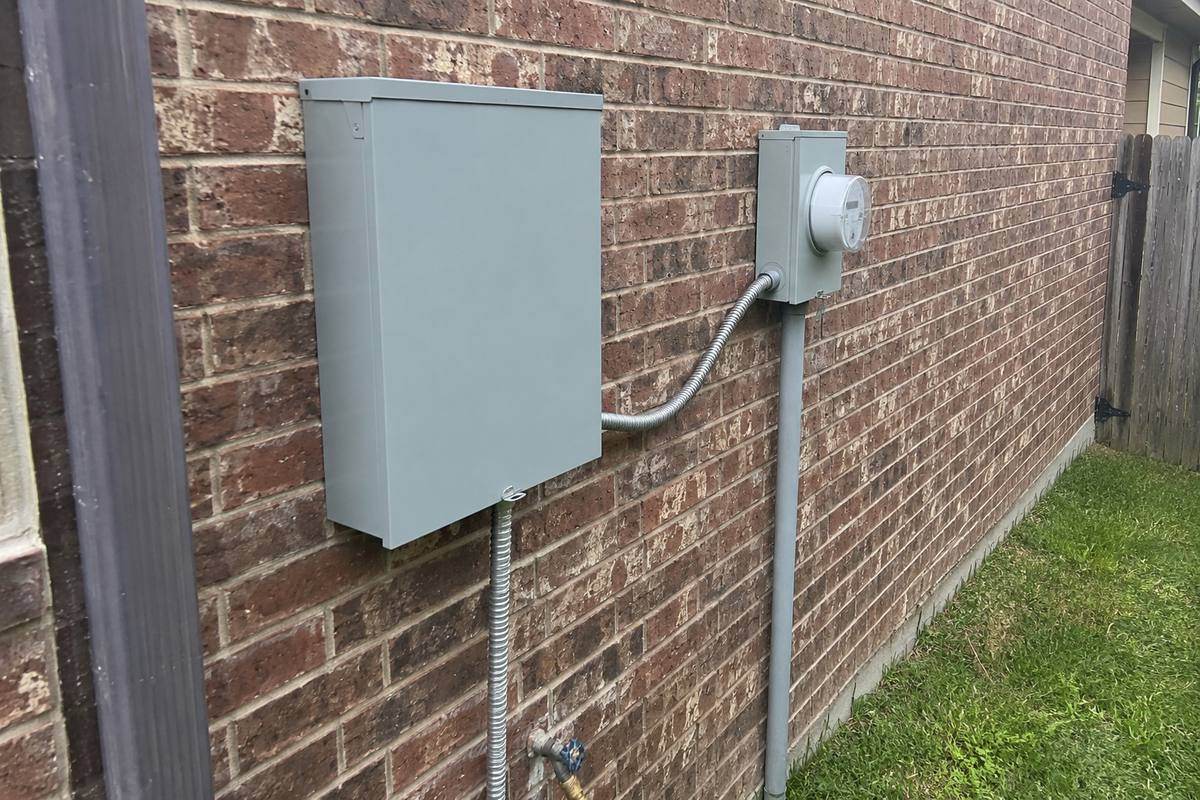
Standby units in this region normally run on natural gas where a gas main reaches the property, or on propane from an on-site tank where it does not — which, on unincorporated acreage, is common. Natural gas removes the refueling question entirely but requires a gas line sized for the unit’s demand, and that sizing is a real design step rather than a formality: a meter and piping adequate for a range, a furnace and a water heater is not automatically adequate with a generator added. Propane needs tank capacity matched to how many days of runtime the household wants, and the tank has its own siting rules.
Siting is governed by the manufacturer’s installation instructions and by clearances from openings, combustibles and property features, plus exhaust direction away from windows, doors and air intakes. On a slab-on-grade lot the pad question is straightforward; on ground that holds water it is not, and elevation matters here for the obvious reason. In much of unincorporated Fort Bend County the relevant county permit is the floodplain or development permit rather than an electrical one — the county permits fully enclosed structures and slabs of 400 square feet or more, along with driveway and culvert work in county right-of-way, platting and on-site sewage facilities. Generator pads are usually well under that threshold, but flood-zone status is worth confirming before concrete is poured.
Set the noise expectation early too. A standby unit exercises itself on a schedule, typically weekly or biweekly for a few minutes. On five acres nobody notices. On a small city lot the neighbors do, and choosing the exercise window thoughtfully is cheaper than relocating the unit later.
Angi’s Houston survey data breaks installed cost by capacity: 7.5–10kW at $9,000 to $13,000, 14–18kW at $11,000 to $15,000, and 20–24kW at $13,000 to $16,000. Put plainly, $11,000 to $16,000 installed is the usual range for a unit large enough to carry a whole Fort Bend house, with smaller partial-coverage units below that. Those are survey ranges, not quotes, and the spread inside them is driven by the things this page has already named: the length of the run between the unit and the service, whether gas piping needs upsizing, pad and elevation work, and whether the existing panel is ready to be fed at all.
Permits: $400 to $1,400 where a city requires one, and none in unincorporated county, where there is no county electrical permit and no county electrical inspection. Inside a city, expect the electrical permit alongside a mechanical or gas permit, and expect the code edition to matter — Fulshear and Meadows Place enforce the 2014 NEC while Missouri City and Richmond enforce the 2023, three cycles and nine years apart within one county. Which rules apply at your address →
Maintenance is the line item people forget. A standby generator is an engine, and an engine that sits still still needs oil and filter changes, air and fuel filters, spark plugs, battery replacement on a cycle, and someone confirming the exercise run actually happened. A unit that has not been serviced in six years is a decoration. Budget for a service interval the way you would for a vehicle, and check the exercise log rather than assuming.
Plenty of generators in this region get bought in the fortnight after an outage, at the worst prices and on the longest lead times, by people who will not think about the decision again for four years. That is a bad way to buy a five-figure appliance, so here are the numbers as they stand rather than as memory has them.
CenterPoint reported roughly a 45% reduction in customer outage minutes in the first half of 2025 against 2024, and about 33% fewer vegetation-related outages. The Public Utility Commission of Texas approved a $2.7 billion systemwide resiliency plan covering 2026 through 2028 in August 2025 — proposed at $5.75 billion, settled at $3.2 billion and trimmed to $2.7 billion on approval. Through the winter storm of January 25–26, 2026, CenterPoint reported that 99% of customers kept power. The direction of travel is improvement, and anyone selling standby power on the premise that the grid is collapsing is selling on a premise the record does not support.
None of that argues against a generator. It argues for buying one the way you buy insurance: on the size of the consequence rather than the vividness of the last event. If the consequence at your address is a warm night and a lost freezer, that is a real but bounded cost. If the consequence is no water and no working septic system for a family, that is a different order of problem and it is worth engineering against, in February, at an unhurried price, with a proper load calculation behind it. Pair the decision with whole-home surge protection while a licensed electrician has the panel open — restoration cycling does more cumulative damage to equipment than most single strikes.
Yes — if those circuits are in the load calculation and inside the transfer switch. A submersible well pump has a large starting current, and an aerobic septic system runs a compressor, a pump and a control panel with an alarm circuit. Both are easy to leave off an essential-circuits list built around lights and a refrigerator, and on an unincorporated property both are usually the whole reason backup power is being considered. Name them explicitly before anyone sizes a unit.
Angi’s Houston survey figures run $9,000–$13,000 at 7.5–10kW, $11,000–$15,000 at 14–18kW and $13,000–$16,000 at 20–24kW. For a unit large enough to carry a whole Fort Bend house, $11,000 to $16,000 installed is the usual range; smaller partial-coverage units sit below it. Permits run $400 to $1,400 where a city requires one and none in unincorporated county. Treat all of that as ranges, never as a quote.
Ask what you want to be true at 3am on the second day. Essential circuits keeps a defined list alive for less money and asks the household to manage its use. Whole home puts the transfer switch ahead of the entire load center, usually with automatic load shedding, and behaves like ordinary life at a higher price. On a well-and-septic property the minimum viable list is longer than people expect, which often narrows the gap between the two options.
Treat it as insurance rather than a reaction. CenterPoint reported roughly a 45% reduction in customer outage minutes in the first half of 2025 against 2024 and about 33% fewer vegetation-related outages; the PUCT approved a $2.7 billion resiliency plan covering 2026–2028 in August 2025; and 99% of customers kept power through the January 2026 winter storm. The trend is good. The question a generator answers is not how often the power goes but what it costs you when it does — and on a well and a septic system, that answer has not improved at all.
Say whether the property is on private water, on-site sewage or municipal service, roughly what the house runs, and what the panel door reads. That is enough to get connected with an independent TDLR-licensed electrician working in Fort Bend County.
Call (346) 857-1116 Request a Quote Fort Bend