Home › Services › Well Pump & Septic Circuits
There is no city main behind the taps on a country property and no municipal sewer under the yard — there is a pump lifting water out of a well casing and, in most cases, a second system with its own pump, compressor and control panel handling everything the household sends the other way. Both run on electricity, and when the electrical side of either one fails the household notices within minutes. Describe what stopped or what is alarming, and get connected with an independent, TDLR-licensed electrician working in Fort Bend County.
Close to three in five Fort Bend County residents live outside a city — 487,457 of 822,779 at the 2020 census — and across the county’s 861.72 square miles a great many of those properties are on private water and on-site sewage. For them, two circuits do work that a city resident never thinks about once.
The first feeds the well. A submersible pump sitting down in the casing, or a jet pump at the surface, moves water into a pressure tank; a pressure switch watches the tank and tells the pump when to run. Nothing in the house has water pressure that does not come through that sequence.
The second feeds the treatment system. An aerobic on-site sewage facility runs an air compressor to keep the process aerobic, a pump to move treated effluent, and a control panel that sequences all of it and carries an alarm. Neither circuit is decorative and neither is optional, which is why they deserve better than being an afterthought at the bottom of a panel schedule. This page covers what the electrical side of both looks like, what fails in it, and how to tell which side of a problem you are actually on.
A submersible pump hangs on the drop pipe inside the well casing with its motor underwater, pushing rather than pulling, which is why it handles depth well. Its conductors run up the casing, out through the well head and to whatever controls it. Depending on the motor, that means a two-wire arrangement with the starting components built into the motor itself, or a three-wire arrangement with an external control box holding the start capacitor, relay and sometimes a run capacitor. The control box is a genuine failure point and it is the one people forget exists.
A jet pump sits at the surface, in a well house or a utility space, and pulls water using suction. It is limited by depth in a way a submersible is not, but everything about it is accessible, which changes the diagnostic conversation entirely.
Both need the same underlying things done properly: a dedicated circuit sized for the motor, not shared with anything else; correct overcurrent protection for a motor load rather than a general-purpose breaker chosen by guesswork; a disconnecting means within sight of the equipment so nobody is working on a pump that something else can energize; and terminations and splices at the well head made with materials rated for a wet location, because that connection lives outdoors in the weather for decades.
Distance matters here as much as it does for a shop. A well house two hundred feet from the panel needs the same voltage-drop calculation described on the subpanel and outbuildings page — a motor fed at reduced voltage draws more current, runs hotter and dies younger, and the failure shows up as a pump that seems to have worn out early rather than as an obvious wiring fault.
An aerobic system is more machinery than most owners realize. The control panel is the part with electrical requirements: it powers and sequences the air compressor, controls the pump that discharges treated effluent, and monitors conditions through float switches. It is mounted outdoors in a rated enclosure, it is exposed to sun, rain and heat year after year, and it is frequently the oldest untouched electrical assembly on the property.
The part worth understanding is the alarm circuit, which is both audible and visual — a horn or buzzer and a light — because either one alone can be missed. A light on a panel at the back of a lot is invisible from the house; a buzzer alone tells you nothing once it has been silenced. Together they signal that a monitored condition is out of range: high water level, a compressor that has stopped, a pump that is not running. Silencing the audible side is deliberately designed not to clear the condition, and the indicator normally stays lit while the fault persists.
Common electrical failures on this side: a tripped or failed breaker feeding the panel, contactors and relays worn out from cycling, a compressor drawing locked-rotor current and tripping protection, float switches that have failed wet or failed dry, corrosion inside an enclosure whose gasket gave up, and insects — which colonize outdoor enclosures in this climate with enthusiasm. The alarm circuit itself can fail too, in both directions: an alarm that will not clear after the real condition is fixed, or worse, an alarm that never sounded when it should have.
One boundary this page will not cross. Fort Bend County Environmental Health permits on-site sewage facilities and runs the inspection cycle for them. Anything specific about system requirements, permit applications, fees, inspection timing or an owner’s ongoing obligations should be confirmed directly with Fort Bend County Environmental Health rather than taken from a web page — those details were not verified for publication here, and getting them wrong would cost a reader more than looking them up.
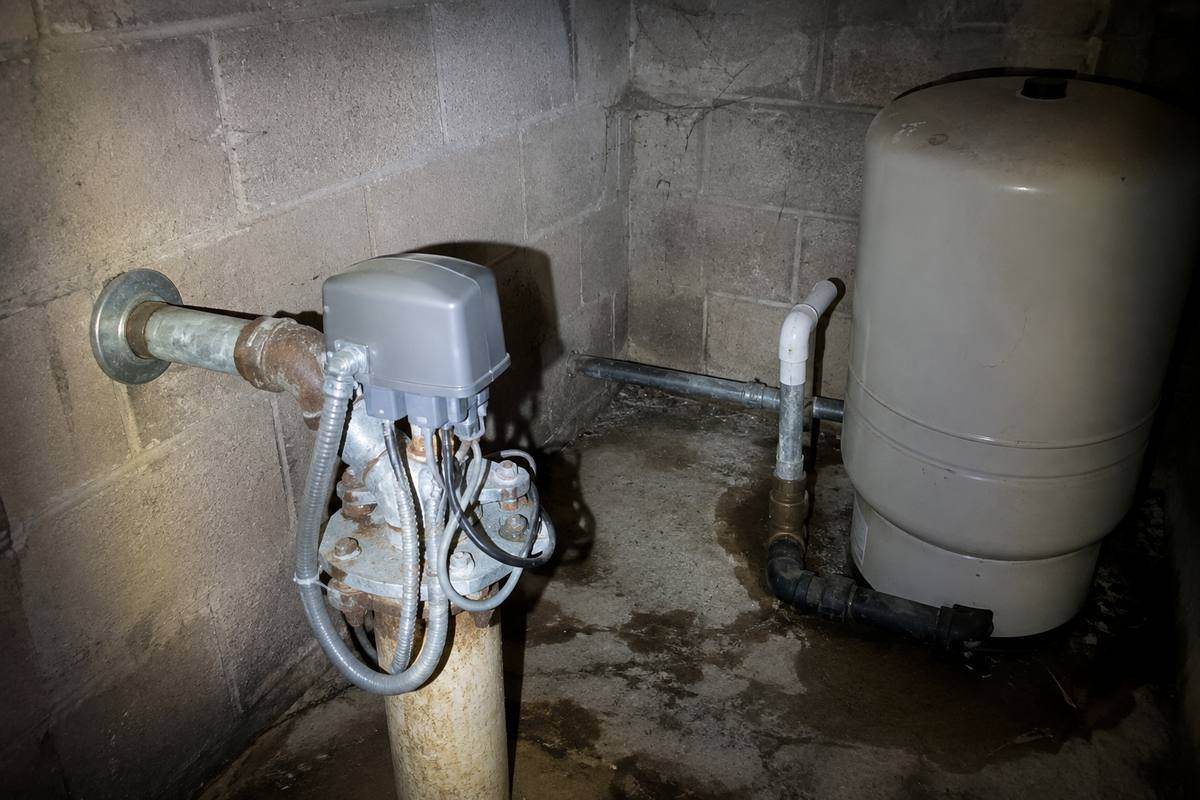
Air spits out of the taps, pressure falls away and nothing comes back. Before assuming the pump has failed — an expensive assumption, because confirming it means pulling pipe — the electrical questions come first. Has the breaker tripped? Is the pressure switch getting voltage, and are its contacts making? Has a start capacitor or relay in the control box failed? Has a splice at the well head corroded, or has something chewed a conductor? Several of those present identically and only one of them involves a crane.
A motor circuit that trips is telling you something specific. It may be an overload — a pump working against a restriction, a failing bearing, a motor drawing more than it should. It may be a ground fault in the conductors down the casing or in the motor windings, which water and time produce eventually. It may be a breaker that is simply the wrong type or size for a motor load, or one that has weakened. Resetting it repeatedly is the one response that is definitely wrong. What a tripping breaker rules in and out →
The horn has been silenced, the light is still on, and the system appears to be running. That is either a monitored condition that has not actually been resolved — a float still up, a compressor still stopped — or a fault in the alarm circuit itself, in a float switch, or in the control panel’s relays. The two need separating, and the septic side of the question belongs with a licensed on-site sewage professional and Fort Bend County Environmental Health while the circuit side belongs with a licensed electrician.
Related symptoms worth naming on the phone rather than diagnosing yourself: lights that dim hard every time the pump starts, which can point at a loose termination or at voltage drop on a long run, and equipment behaving strangely after a restoration, which on a long rural service drop is as often the utility’s side as yours.
These two facts sit side by side and they surprise people. On the septic side, Fort Bend County Environmental Health permits on-site sewage facilities and runs the inspection cycle — it is one of the genuine permitting functions the county performs in unincorporated areas, alongside floodplain and development permits, driveway and culvert permits in county right-of-way, sign permits and subdivision platting. Contact that office directly for anything specific; this page deliberately publishes no figures, intervals or technical requirements for it.
On the electrical side, nothing. Fort Bend County’s own building-codes page states that the county “has not adopted zoning ordinances and does not issue Certificates Of Occupancy,” and the only county-adopted code that reaches buildings is the 2021 International Fire Code with local amendments, effective October 1, 2023, which the Fire Marshal’s Office administers for certain multi-family and non-residential development. It is not a residential electrical code. There is no county electrical permit and no county electrical inspection for the circuit feeding a well pump or a septic control panel.
So the treatment system gets a permit and an inspection cycle, and the wiring that keeps it alive gets neither. The state license still applies at every address — Occupations Code §1305.151 bars performing or offering to perform electrical work without one and §1305.303 makes an offense a Class C misdemeanor — but with no permit there is no moment at which anybody looks, so enforcement is complaint-driven and arrives after the fact. That is exactly why asking for the company’s license number and checking it against TDLR’s free public search matters more here than in a city, and why a private electrical inspection is often the only qualified look this equipment ever gets. The county-wide permit position →
Everything above assumes there is power at the property. Remove that and both systems stop at once: no pump means no pressure and no water at any faucet within minutes of the tank drawing down, and no control panel means the treatment side stops while the household carries on producing. An electric water heater is irrelevant at that point because nothing is filling it.
That is the durable Fort Bend case for standby power, and it is a stronger case than the storm one. It does not depend on hurricane season or on how bad the last winter was — it depends only on whether pumps stand between the household and its water and waste. The two loads also have to be named explicitly when a generator is sized, because a submersible pump has a large starting current and a septic compressor and control panel are easy to leave off an essential-circuits list drawn up around lights and a refrigerator.
The whole-home generator page covers sizing, transfer switches, fuel, siting and installed cost ranges, and it treats the purchase as insurance rather than a reaction. Buy on the size of the consequence at your address, not on the vividness of the last event.
Frequently the wiring, and it is worth establishing before anyone pulls pipe. A tripped breaker, a failed pressure switch or burnt switch contacts, a failed capacitor or relay in the control box, a corroded splice at the well head or a chewed conductor all produce the same symptom as a dead pump: no water anywhere. A licensed electrician can separate the electrical side from the mechanical side without a well rig on site, which is usually the cheaper order to do things in.
Yes. It is a motor load with a large starting current and belongs on a dedicated circuit sized for that motor, with correct overcurrent protection and a disconnecting means within sight of the equipment. Sharing it causes nuisance tripping and voltage sag at start. Where the well house is a long way from the panel, the voltage-drop calculation matters too — a motor fed low draws more current and fails early, and it looks like a worn-out pump rather than a wiring problem.
That a monitored condition is out of range — commonly a high water level, a stopped air compressor or a pump that is not running. The alarm is both audible and visual by design, and silencing the horn does not clear the condition; the light normally stays on while it persists. The alarm circuit and its float switches can also fail in their own right, which is why an alarm that will not clear after the real problem is fixed is a separate fault to chase. For the treatment system itself, its permitting and any owner obligations, contact Fort Bend County Environmental Health, which permits on-site sewage facilities and runs the inspection cycle.
Two different answers. Fort Bend County Environmental Health permits the on-site sewage facility and runs its inspection cycle; confirm all specifics with that office directly. The electrical circuits are not permitted or inspected at all in unincorporated county, because the county has adopted no residential building code. The state license applies at every address regardless, so ask for the company’s license number and check it on TDLR’s free public search — where no permit exists, that check is the only verification available. Permits, city by city.
Say whether it is the well side or the septic side, what the breaker is doing, and roughly how far the equipment sits from the panel. That is enough to get connected with an independent TDLR-licensed electrician working in Fort Bend County.
Call (346) 857-1116 Request a Quote Fort Bend