Home › Services › Panel Upgrades
A 100-amp service was a generous specification in 1972 and a 150-amp one was ample in 1994, and neither number moved when a second condenser went in, a pool went up, a shop went in at the back of the lot and a car started charging in the garage overnight. Say what the panel door reads and what the house is being asked to run, and get connected with an independent, TDLR-licensed electrician working in Fort Bend County.
Almost every useful conversation about a service upgrade starts with two pieces of information you can collect yourself, without tools and without taking anything apart. Open the outer door of the panel — the door, not the inner cover held on by screws. Read the maker’s name printed on the label inside, and read the number stamped on the handle of the large breaker at the top or the bottom of the column. That number is the service size in amps: 100, 125, 150 and 200 are the common ones on a house.
If there is no single large breaker, the panel is main-lug and the disconnecting means sits somewhere else, usually out at the meter. The label will still carry a bus rating. Either way, the label plus the amp number tells a licensed electrician more in one sentence than a page of description does, and it decides which of two very different jobs is on the table: adding capacity to a service that has headroom, or replacing the service itself.
Something You Can Check Yourself
Count the empty spaces in the panel while the door is open, and look at whether any circuits are already sharing a slot with a slim double-stuff breaker. Spaces and capacity are two separate questions — a panel can be physically full at 200 amps and physically half-empty at 100 — but the count is worth knowing before anyone quotes an EV charger circuit or a shop subpanel.
Federal Pacific Stab-Lok equipment was manufactured from roughly 1950 to 1980 and kept appearing in houses built into the late 1980s as existing stock was used up. In March 1983 the Consumer Product Safety Commission closed a two-year investigation without issuing a recall, saying it had “insufficient data to accept or refute” the manufacturer’s position and would not commit further resources — while stating in the same release that “Commission testing confirmed that these breakers fail certain UL calibration test requirements.” A 2002 New Jersey Superior Court ruling in a consumer-fraud class action is a court finding about the company’s conduct, and it is a separate thing from a federal safety determination. Keep the three apart and the honest summary is: not recalled, not cleared, and worth a licensed electrician’s eyes.
Zinsco and Sylvania-Zinsco panels are flagged routinely by home inspectors, with reported burn-up at the connection between the breaker and the bus. The honest position — and one this site would rather state than paper over — is that the evidence base behind Zinsco is thinner than the one behind Federal Pacific. There is no CPSC, NFPA or UL finding standing behind it, and the inspection trade itself acknowledges it lacks statistically solid data. Treat the name as something to look for on the label and to have assessed on site. Nothing on this page claims how many exist, where they are, or what any individual panel is doing.
Neither name is a diagnosis from a web page. Both are a reason to book an inspection or to raise the make when a panel change is already being priced for capacity.
Fort Bend County is not an old-housing market and pretending otherwise would be dishonest. The Census Bureau’s American Community Survey (2020–2024 five-year estimates) puts the county’s median year built at 2005, with 61.5% of the stock finished since 2000 and only 4.1% predating 1970. Most of the 305,633 housing units here left the builder with a modern service size and modern protection.
Where original 100A and 150A service does turn up is specific and worth naming: Richmond’s historic core, which is the oldest built environment in the county; Stafford; the 1970s ring in Missouri City, where Quail Valley began in 1969 and built out mostly through the 1970s alongside Hunters Glen, Briargate, Meadowcreek and Fondren Park; the rail-town core of Rosenberg; Meadows Place, whose housing was essentially finished before the city incorporated in 1983; and the small west-county towns.
It is not Fulshear, whose housing is essentially all post-2010. It is not Cross Creek Ranch, not Harvest Green, and not the later phases of Cinco Ranch. In those places the panel is usually fine and the question is a different one — how much of the existing 200-amp service is already spoken for. That is a load calculation, not an upgrade, and it is the more common call in this county by a wide margin.
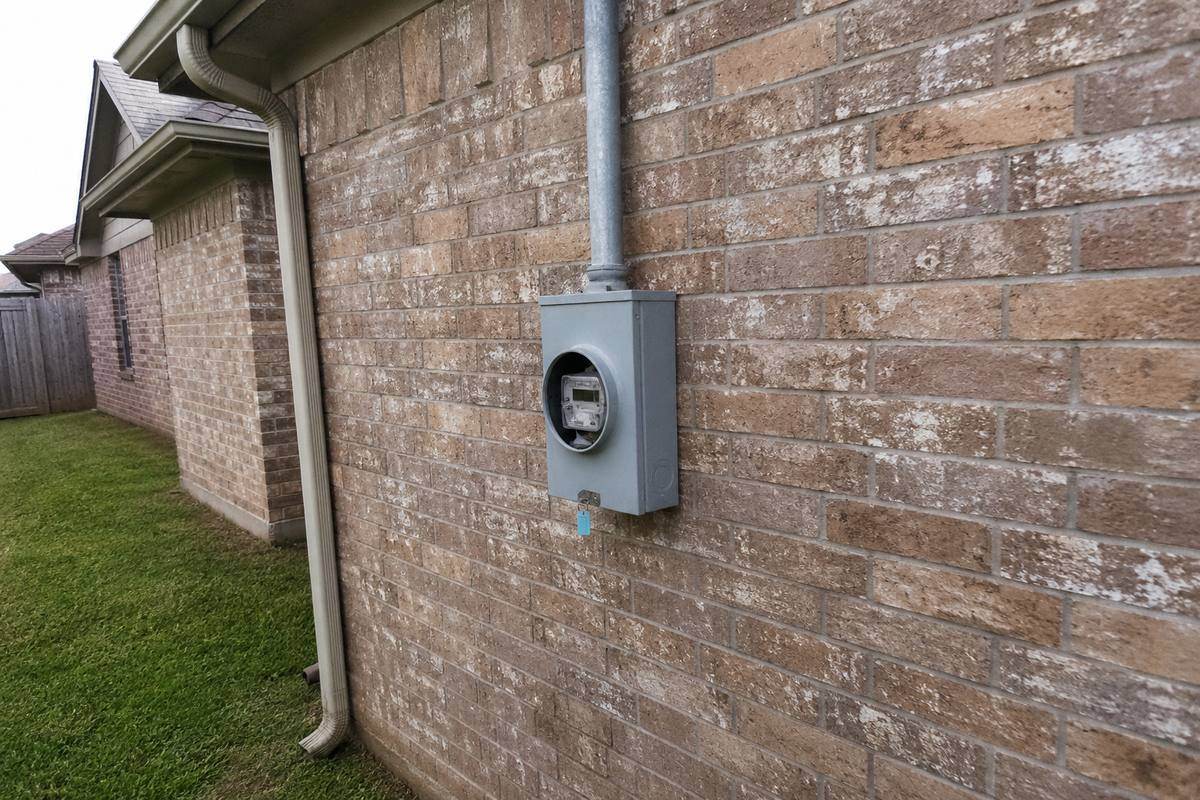
This is the single most common misunderstanding a Texas homeowner brings to a service upgrade, and it costs people weeks. In the deregulated market the company that bills you is a retail electric provider. It sells energy and runs the account. It does not own a wire, a meter or a pole. The wires-and-poles side belongs to the transmission and distribution utility, and across this county that is CenterPoint Energy, whose own Tariff for Retail Delivery Service names Fort Bend among the twelve counties in its certificated service area and which runs a dedicated Fort Bend and Wharton service area out of Rosenberg, Richmond and Needville.
CenterPoint owns the meter — its tariff states that meters for residential retail customers shall be company owned — and it maintains the facilities and equipment at the point of delivery, including the service disconnect, regardless of which retailer sells the energy. So a service upgrade sequences through CenterPoint’s electric service request process, not through the retailer. Calling the name on the bill to ask for 200 amps gets a polite explanation and no progress.
In practice the order looks like this. The licensed electrician establishes what the house needs, the service request goes to CenterPoint, and the disconnect and reconnect are scheduled against it. Where a city permit applies, that runs in parallel and the inspection is timed so the utility is not reconnecting to unapproved work. Service territory is set by address rather than by city name, so if the property sits near a county line it is worth confirming directly with CenterPoint or through the PUCT’s Power to Choose site, which searches by ZIP — noting that a ZIP is imprecise where boundaries split.
People picture a box swap. A service upgrade is usually a good deal more than the box. Depending on what is already there, the scope can include a new load center and breakers, a new meter base, a new mast or riser and weatherhead where the service is overhead, new service-entrance conductors, a grounding electrode system brought up to the current requirement, bonding at the water and gas piping, and the re-landing of every branch circuit onto the new bus. Where the existing panel sits in a spot that no longer has legal working clearance in front of it, relocation enters the scope too.
On cost, here is the honest framing. National survey data puts a 100A to 200A upgrade at roughly $1,300 to $1,600, and $1,800 to $2,500 where a new service panel is required, with a meter box at $200 to $500. Those are national figures and they should be read as a floor for a Houston-area job, not as a quote. A Fort Bend service upgrade also carries CenterPoint coordination and frequently mast, riser and meter-base work that the national averages do not fully absorb. Anyone who prices your job from a web page is guessing; anyone who prices it after looking at the meter base, the mast and the grounding is doing it properly.
Two related numbers, for context rather than for your quote. Adding a Level 2 charger to a panel that needs upgrading first carries a panel upgrade adder of $800 to $2,000 in the same national data — the detail sits on the EV charger page. And a whole-home rewire is a different animal entirely, running at $2 to $4 per square foot in Angi’s Houston figures; that is the rewiring page, and it is rarely what a panel conversation turns into.
Fort Bend County’s own building-codes page reads: “Fort Bend County has not adopted zoning ordinances and does not issue Certificates Of Occupancy.” The same page notes that the Fire Marshal’s Office does issue Certificates of Compliance for certain multi-family and non-residential developments, under the 2021 International Fire Code with local amendments, adopted September 26, 2023 and effective October 1, 2023. That is a commercial and multi-family instrument. It is not a residential electrical code, and there is no county electrical permit and no county electrical inspection for a panel swap on an unincorporated Fort Bend house.
Close to three in five county residents live outside a city — 487,457 of 822,779 at the 2020 census — so for a large share of readers, nobody external ever looks. Nor does a city’s extraterritorial jurisdiction fill the gap: a Texas municipality cannot enforce its building codes or require building permits in its ETJ (Town of Lakewood Village v. Bizios, 493 S.W.3d 527 (Tex. 2016), extended to home-rule cities in Collin County v. City of McKinney, 553 S.W.3d 79 (Tex. App.—Dallas 2018)). A Richmond or Katy mailing address is a postal routing decision.
Inside a city, a panel change is permitted work and the code edition matters. Missouri City and Richmond enforce the 2023 NEC; Fulshear and Meadows Place enforce the 2014 NEC; Stafford is on the 2017. That is three code cycles and nine years apart inside one county, and it changes real requirements on a service upgrade. Rosenberg’s edition is unsettled — its residential builders packet cites the 2017 NEC while its current residential solar permit application requires design to the 2023 — so confirm with the city. What never changes is the state license: Occupations Code §1305.151 bars performing or offering to perform electrical work without one, city or no city, and §1305.303 makes an offense a Class C misdemeanor. The full city-by-city position →
Open the panel door and read two things: the maker’s name on the label and the number stamped on the handle of the main breaker. That number is the service size in amps — 100, 125, 150 and 200 are the usual ones. If there is no single main breaker, the panel is main-lug fed and the disconnect sits elsewhere, often at the meter; the label will carry a bus rating instead. Those two pieces of information decide most of what follows.
CenterPoint. The retail provider on your bill sells energy and runs the account; it owns no equipment. CenterPoint owns the meter and maintains the equipment at the point of delivery no matter which retailer you buy from, so a new or upgraded service goes through CenterPoint’s electric service request process. Its tariff lists Fort Bend among its twelve certificated counties and it runs a Fort Bend service area out of Rosenberg, Richmond and Needville. Service territory follows the address rather than the city name, so confirm yours if you are near a boundary — ask CenterPoint directly, or use the PUCT’s Power to Choose site, which searches by ZIP.
In unincorporated Fort Bend County, no — the county has adopted no residential building code, issues no electrical permit and performs no electrical inspection. Inside Missouri City, Richmond, Rosenberg, Stafford, Fulshear, Meadows Place or Needville, yes, and the requirements and code editions differ. The state license applies in both cases; only the checking changes. Permits, city by city.
No. The right answer comes out of a load calculation against what the house actually runs and what is being added — a second condenser, a pool, a shop, a charger, a standby generator. Plenty of Fort Bend houses on an existing 200-amp service need a subpanel or a load-management device rather than a bigger service, and plenty of older houses on 100 amps need the service replaced before anything else is worth discussing. A licensed electrician does that arithmetic on site; a web page cannot.
The build year of the house, the name on the panel label, the number on the main breaker, and what you are adding. That is enough to get connected with an independent TDLR-licensed electrician working in Fort Bend County.
Call (346) 857-1116 Request a Quote Fort Bend