Home › Services › Electrical Inspections
Across most of this county the electrical work in a house has never been looked at by anyone qualified. No permit when it was done, no inspection after it, none at closing. A pre-purchase electrical inspection is the one point in a house’s life where that changes — and it is voluntary. Get connected with an independent, TDLR-licensed electrician working in the county.
Fort Bend County’s own building-codes page says it plainly: “Fort Bend County has not adopted zoning ordinances and does not issue Certificates Of Occupancy.” The same page notes the Fire Marshal’s Office does issue Certificates of Compliance for certain multi-family and non-residential developments — the county adopted the 2021 International Fire Code with local amendments, effective October 1, 2023. That reaches commercial, public and multi-family buildings. It is not a residential electrical code, and there is no county electrical permit or inspection behind it.
Close to three in five Fort Bend residents live outside a city — 487,457 of 822,779 at the 2020 census. For that majority, a panel change, a subpanel or an added room went in with no plan review, no rough-in and no final. A city’s extraterritorial jurisdiction does not fill the gap: Texas cities cannot enforce building codes or require building permits in their ETJ, per Town of Lakewood Village v. Bizios, 493 S.W.3d 527 (Tex. 2016), extended to home-rule cities in Collin County v. City of McKinney, 553 S.W.3d 79 (Tex. App.—Dallas 2018).
The license requirement never went away — Occupations Code §1305.151 bars performing or offering to perform electrical work without one. What is missing is not the rule. It is the moment anybody checks. Inside a city that moment is the permit inspection; outside one, enforcement is complaint-driven and arrives after something has gone wrong. A private inspection is the only way to move it to before you own the house.
One appointment covering foundation, roof, attic, plumbing, HVAC, appliances and electrical among the rest — a broad visual survey under a standard of practice that keeps it non-invasive and generalist by design. The output is a flag: something appears wrong, further evaluation recommended. Not a hedge; the correct end of that scope.
A licensed electrician spending the whole visit on one system. The deadfront comes off. Terminations, bonding and grounding, conductor sizing against breaker sizing, and service-equipment condition get evaluated against the code by somebody who does the corrective work for a living. The output is a diagnosis and a scope.
None of that is a criticism of home inspectors; it is scope. Both are worth having, but where budget forces a choice, the specialist visit is the one that changes a negotiation — “further evaluation recommended” is not a number, and a scope is.
Before booking anything, go and read the label. The manufacturer’s name and the main breaker’s amp rating shape the whole conversation and are free to collect. Service size sets what the house can be asked to do: 100A on a 1970s house that has since acquired a second condenser, a pool and a shop is a capacity question regardless of whether anything is wrong.
One name carries a documented federal history. Federal Pacific Stab-Lok panels were made from roughly 1950 to 1980 and appear in houses built into the late 1980s as stock was used up. CPSC closed a two-year investigation in March 1983 without issuing a recall, saying it had “insufficient data to accept or refute” the manufacturer’s position — while also stating that “Commission testing confirmed that these breakers fail certain UL calibration test requirements.” Both halves belong in the sentence. Zinsco is a separate case inspectors flag, with reported burn-up at the breaker-to-bus connection, on a thinner evidence base.
Something You Can Check Yourself
Open the panel door — the outer door only, not the inner cover — and write down three things: the maker’s name, the number stamped on the main breaker handle, and whether the circuit legend is filled in, blank, or covered in later handwriting in a different pen. A legend crossed out and rewritten is a record of work done after the house was built, and the cheapest early indicator there is.
The county is young — median year built 2005, only 4.1% before 1970. On most Fort Bend houses the original wiring is not the question. The additions are. Twenty years of adaptation where nothing external ever looked leaves recognizable traces:
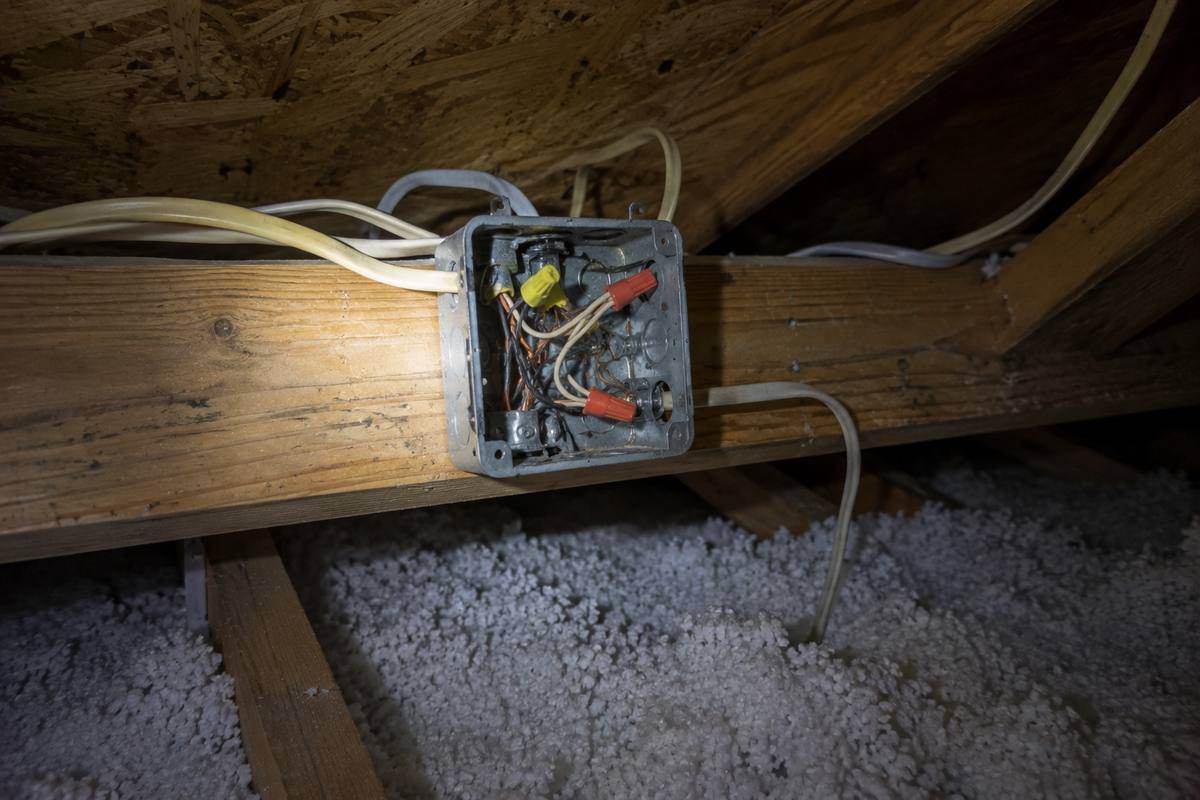
Junction boxes with no covers, splices made outside a box entirely, cable stapled across the top of joists, a box buried under blown-in, and cable spliced mid-run to reach an addition.
Two conductors under one breaker lug, a breaker rating that does not match the conductor it feeds, mixed manufacturers where a replacement used whatever fit, missing knockout covers, a subpanel wired like a main.
An interior-rated receptacle on a patio, a cord run permanently to a shed, a hot tub with no disconnect in sight, a converted garage on a circuit that once served two receptacles.
Protection coverage reads by era too, mapping to build year rather than any local rule. Ground-fault protection reached outdoor receptacles in the 1971 NEC, bathrooms in 1975, garages in 1978, all kitchen countertop receptacles by 1996; arc-fault protection was required for bedrooms by the 1999 NEC with a mandatory date of January 1, 2002, so a 1990s house was built with none. That is age, not a defect — exactly what a report should state plainly rather than alarm a buyer with. Where the conductors are aluminum, that is a distinct subject: aluminum wiring remediation →
Ask before booking, not after. Specify four things: photographs of every finding, not a list of terms; findings sorted into safety, code and maintenance; the service size, panel make and model recorded plainly; and what correcting each item involves. A report a buyer cannot hand to a third party and have understood is worth less than it cost. Ask for the license number too and check it on TDLR’s free public search — out here no permit will ever create a second record that anybody qualified was present.
Then use it properly. A findings list is not a repair-demand list. Sort it into genuine safety items, era artifacts the house has always had, and deferred maintenance any buyer inherits — the safety items are what to price and negotiate. A number attached to a photograph survives a counter-offer; a round figure in an amendment does not.
Sellers get the same value earlier: a pre-sale inspection turns a buyer’s surprise into a disclosed, already-priced item — a far weaker lever than a discovery three days before the option period ends. Whether the answer is a panel change, a rewire or a fault to trace, knowing before listing is worth the visit alone.
Two different jobs at two different depths. A general inspection is a broad, non-invasive visual survey across every system in one appointment. An electrician spends the whole visit on one system, takes the deadfront off, and can say what correcting a finding costs. One report says something looks wrong; the other says what it is.
Often, for a different reason than on an old one. A newer Fort Bend house rarely has a condition problem — it has alterations: a converted garage, an outdoor kitchen, a shop, a pool, a charging circuit, none of which carried a permit or inspection in unincorporated county. The house is new; the additions are the question.
No. It is a private, voluntary survey commissioned by an owner or buyer, not a municipal inspection, and it neither closes out earlier unpermitted work nor replaces a permit on future work. In unincorporated county there is nothing to satisfy in the first place. Inside a city, future work follows that city’s adopted edition, and those differ sharply: Fulshear and Meadows Place enforce the 2014 NEC, Missouri City and Richmond the 2023. City by city →
For a buyer, as soon as the general inspection flags anything electrical — early enough that findings can still be acted on. For a seller, before listing. For a house bought to remodel, before the design is fixed, because what the service can carry decides what the plan can include.
Address, year built, what the panel label says, and where you are in the transaction. That is enough to get connected with a licensed Fort Bend County electrician.
Call (346) 857-1116 Request a Quote Fort Bend