Home › Services › Symptoms › Burning Smell From an Outlet
Every other symptom on this site can be observed for a while before anyone does anything. This one cannot. A hot, acrid or fishy smell at a receptacle means something inside that box is running hot enough to break down plastic, and the correct order is act first and diagnose second. Switch the circuit off, then read on and get connected with an independent, TDLR-licensed electrician working in the county.
Unplug what is in it, if you can do that without touching a hot plug body, and switch off the breaker that feeds it. If the legend does not tell you which breaker that is, switching off the main is a reasonable and safe thing to do. Leave it off. Do not plug something else in to see whether the smell comes back — that is the single most common next move and it re-energizes the exact fault you just isolated. Do not remove the faceplate. Do not run an extension cord from that receptacle to keep something going.
If there is smoke, visible flame, a scorch mark spreading beyond the plate, or a smell strong enough to fill the room, leave the house and call 911 rather than working through a checklist. Otherwise, with the circuit dead, the situation is stable and there is time to make a considered call.
The smell is thermoplastic and insulation degrading. Four things commonly produce that heat, and they are not equally easy to put right.
A hot termination is the most frequent: a conductor pushed into the back of a receptacle instead of clamped under a screw, a screw never brought up to torque, a splice made in a hurry. The joint has resistance it should not, and resistance under current makes heat. A failing device is next: after two decades the internal contacts lose their spring, the plug sits loose, and a loose contact carrying a real load arcs. An overloaded connection is the third — a space heater or window unit drawing near the circuit’s limit for hours through a joint that was marginal at ten amps and is not at fifteen.
The fourth depends entirely on the build year. In a house wired between 1965 and the mid-1970s, aluminum branch-circuit conductors may be landed on devices never designed for them. The Consumer Product Safety Commission describes the mechanism precisely: oxidation and creep at the terminations raise resistance, and that increased resistance “causes overheating, sometimes at hazardous levels, when current is flowing in the circuit.” CPSC accepts three permanent repairs — complete replacement with copper, the COPALUM crimp, and the AlumiConn connector — and pointedly does not accept twist-on connectors or CO/ALR devices as permanent. The full aluminum position →
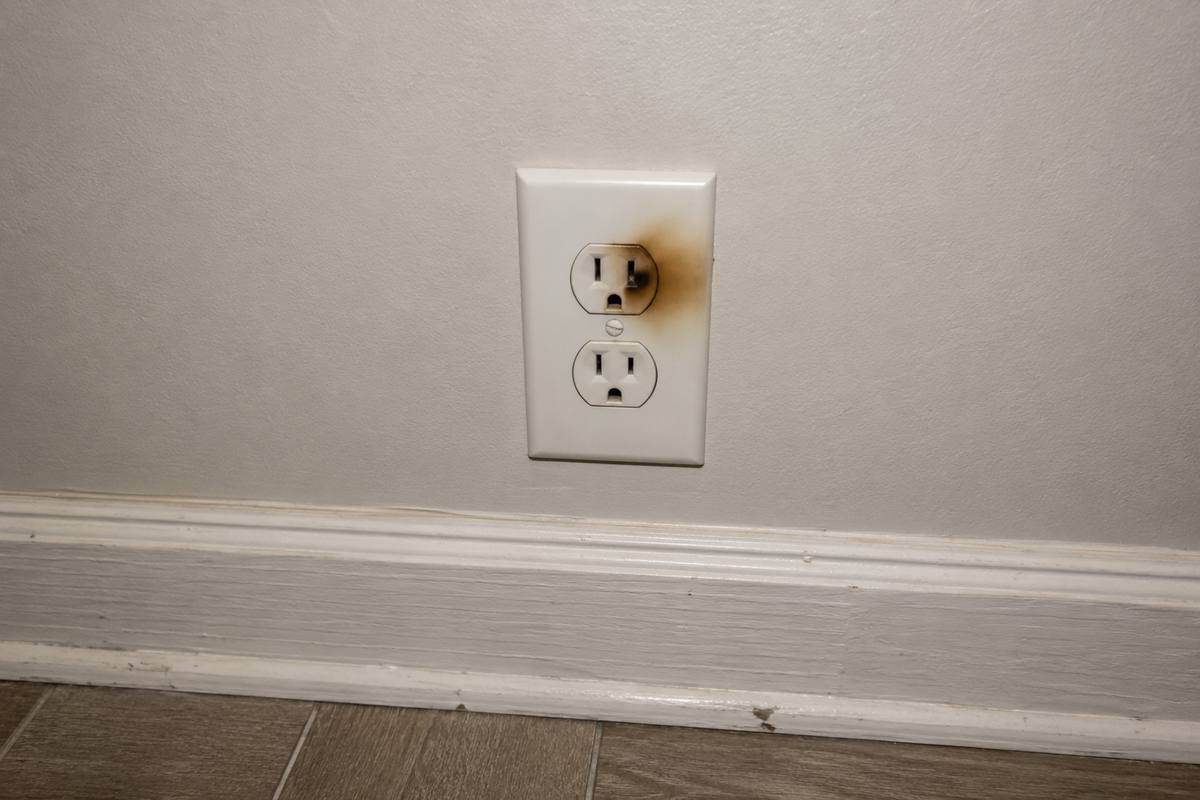
Everything worth reporting is visible with the faceplate on. Brown or yellow staining spreading from one slot is heat that has already happened. Plastic that looks glossy, sunken or distorted around a slot is further along. A faint soot smudge above the plate is further still.
Touch is a fair test once the circuit is off: a faceplate that was warm is not normal — a receptacle carrying a normal load should feel like the wall around it. A plug that falls out under the weight of its own cord, or that has to be wiggled to make an appliance run, says the contacts have lost their grip, and that grip is what keeps the connection from arcing. Buzzing, crackling, visible sparking on every insertion, or an appliance that runs weakly on that receptacle and fine elsewhere all belong on the same list.
Something You Can Check Yourself
With the circuit off, look at every other receptacle and switch in the same room, and at the ones either side of it on the run. Terminations made badly tend to have been made badly on the same afternoon by the same hand. A second discolored plate two rooms away turns a device swap into a circuit review.
“It smelled hot but the breaker never went, so it must be minor” is the most dangerous sentence attached to this symptom. The breaker did nothing because it had no reason to.
An overcurrent device measures current flowing in the conductor. A high-resistance connection does not raise that current — it turns a share of the circuit’s energy into heat at one point — so a circuit can sit comfortably inside its rating while a joint in a box climbs past the temperature its plastic can take. A series arc behaves the same way, making heat, light and noise without adding amperage. An arc-fault device is the only protection built to see that pattern, and it exists only where the house was wired to a cycle that required it: bedrooms from the 1999 NEC with a mandatory date of January 1, 2002, combination devices from the 2005 NEC effective January 1, 2008, kitchens and laundry from 2014. A 1978 house has none of it. No trip is not evidence of safety; it is evidence that nothing in the panel was designed to notice.
Of all the symptoms on this site, this is the one where Fort Bend’s permit position matters most, because terminations are exactly what an inspection looks at. Nothing else about a finished house is so hidden and so dependent on whether one person did one thing carefully.
Fort Bend County’s building-codes page says it plainly: “Fort Bend County has not adopted zoning ordinances and does not issue Certificates Of Occupancy.” The same page notes the Fire Marshal’s Office issues Certificates of Compliance for certain multi-family and non-residential developments under the 2021 International Fire Code, effective October 1, 2023 — a commercial and multi-family instrument with no residential electrical permit behind it. Close to three in five county residents live outside a city. For those houses, no one external has ever opened a device box and looked at a screw — not when the house was built, not when a previous owner added a circuit, and not at closing, because a general home inspection does not remove devices. The state license still applies everywhere; only the checking changes. Who signs off, city by city → · What a private electrical inspection covers →
Yes. A breaker measures current in the conductor, and a poor connection makes heat from resistance rather than from excess current, so the circuit stays inside its rating while one joint chars. A series arc adds no amperage either. No trip means nothing in the panel was built to notice.
Not while it is live, and there is no need. Discoloration, distortion, soot, warmth and a plug that will not grip are all visible with the plate on. Turn the circuit off, leave it off, describe what you saw.
The build year decides. CPSC puts aluminum branch-circuit wiring in homes from 1965 to the mid-1970s. Only 4.1% of Fort Bend County housing predates 1970, so across the county it is rarely the answer — but where the year fits, this exact symptom is the mechanism.
Sometimes. If the device failed, a new one solves it. If a termination overheated, the conductor ends may be damaged and the neighboring devices on the run were probably made the same way on the same day. Replacing only the visible part is how this returns a few feet away.
Say which room, what the plate looks like, what was plugged in, and roughly when the house was built. One call is all it takes to reach a licensed Fort Bend County electrician.
Call (346) 857-1116 Request a Quote Fort Bend