Home › Services › Symptoms › Breaker Keeps Tripping
A tripping breaker is not a fault. It is a report, and there are three very different things it can report: too much current, a short between conductors, or current escaping the circuit altogether. Telling them apart rarely starts with a meter — it starts with noticing when the trip happens. Describe the pattern and get connected with an independent, TDLR-licensed electrician working in the county.
An ordinary breaker holds two mechanisms answering to two kinds of trouble. A thermal element responds slowly to sustained current above the rating — the overload path. A magnetic element responds almost instantly to a huge surge — the short circuit path. A third fault, the ground fault, is current leaving by a route that is not the return conductor: a damaged cable against a metal box, a wet fixture, a failing heating element.
The fixes are unrelated. An overload is arithmetic, and the answer is another circuit. A short is physical — two conductors touching where they should not — and something must be found and replaced. A ground fault is leakage, usually about moisture or deteriorated insulation. Note what follows: only one of the three has anything to do with how heavily the circuit is being used. The reflex assumption is right one time in three.
There is no load to overload. A breaker that will not hold on an empty circuit is reporting a short or a ground fault in the fixed wiring or a hardwired device — a fixture, a switch, a receptacle, the cable between them. The fault is structural, not something you own.
A delay of minutes is the thermal element doing what it was built to do, pointing at a real overload — or a loose termination heating under load until something gives. The tell: if adding the second appliance shortens the time, that is load.
A condenser pulls locked-rotor current for a moment every time it starts, and a failing capacitor, a seizing compressor or a welded contactor stretches that moment until the double-pole breaker feeding it lets go. It reads as an electrical fault and it is a mechanical one; fitting a fresh breaker on that circuit moves the failure about a week down the road. When the breaker that keeps going is the one marked for the outdoor unit, the diagnosis belongs on the mechanical side first.
The appliance is the prime suspect, and you can narrow this yourself without touching anything electrical. Unplug it and use the circuit normally for a day. Moving it to a receptacle on another circuit separates a bad appliance from a bad circuit.
Weather-linked tripping is a ground fault following water, and diagnostically it is a gift. It confines the fault to where water reaches: exterior receptacles, soffit lights, pool equipment, or a buried feeder to a detached shop or well house.
Something You Can Check Yourself
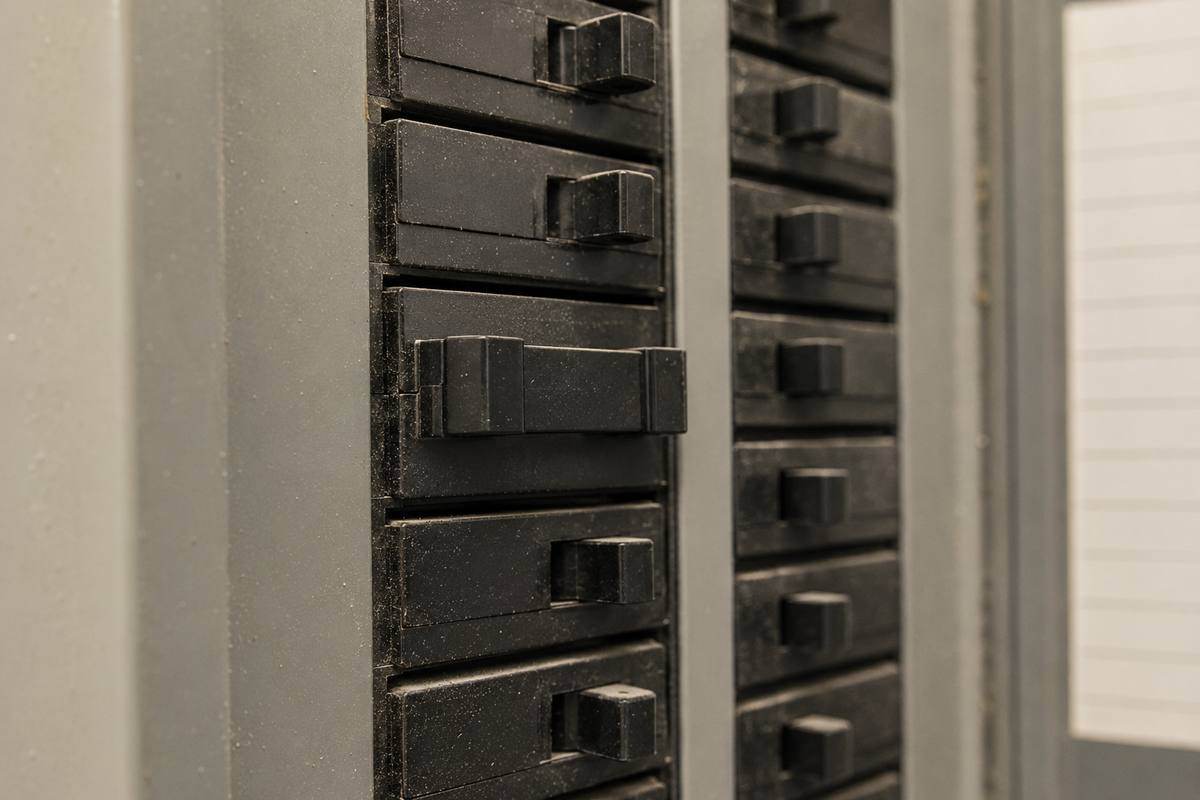
Open the panel door — the door only, never the inner cover — and read the number stamped on the handle of the breaker that trips, plus whatever the legend says that circuit feeds. Then note what was running when it went. Three facts, and they turn a whole-house question into a one-circuit one.
Two families of protective device trip for reasons an ordinary breaker never notices, and treating them as ordinary breakers is the second-biggest source of wrong conclusions here.
A GFCI does not care how much current is flowing. It compares what leaves on the hot conductor with what returns on the neutral and opens if those differ by a few thousandths of an amp, because that difference means current has found another route — possibly through a person. Rain in an exterior box, a damp garage freezer, a pool pump seal, an aging heating element: any of those leak enough to trip a GFCI while sitting nowhere near the amp rating. NEC coverage has widened since outdoor receptacles first required it in 1971: bathrooms 1975, garages 1978, kitchen countertops by 1996, laundry and dishwashers 2014.
An AFCI is doing something stranger. It watches the shape of the current waveform for the signature of an arc — the small repeated spark a loose connection or a damaged cord makes long before anything gets hot enough to smell. Bedrooms first required it under the 1999 NEC with a mandatory date of January 1, 2002, combination-type devices followed with the 2005 NEC effective January 1, 2008, and the 2014 edition added kitchens and laundry. A Fort Bend house finished after 2008 has arc-fault protection across most of its living space, which is why a hard-to-reproduce trip in a newer house is so often an AFCI. Respect it: it reports a condition a conventional breaker cannot see, and that condition is the one that starts fires.
A breaker that trips repeatedly is not failing. It is functioning, over and over, in the presence of something that keeps giving it a reason. The hazard is the two human responses: repeated resetting, which re-energizes a circuit that has already declared a fault, and fitting a higher-rated breaker because the smaller one “nuisance trips.”
A breaker protects the conductor behind it, not the appliance in front of it. A 15-amp breaker exists because the cable it feeds is sized for 15 amps. Put a 20-amp breaker there and the tripping stops while the wire is now allowed to run hotter than its insulation rating, in a wall cavity where nobody sees the consequence until it announces itself. Breakers do fail, but the device gets checked after the circuit. How a fault gets narrowed →
Fort Bend County put up 55% of its housing stock between 2000 and 2019 — Census Bureau American Community Survey, 2020–2024 five-year estimates — at a median year built of 2005. Those houses were wired to the builder’s minimum package and to the appliance schedule on the plan. Every circuit was allocated a job, and the house has since taken on jobs nobody allocated: a garage circuit now carrying a second refrigerator, a freezer and a compressor; kitchen circuits feeding an air fryer, a countertop oven and a coffee machine that draws like a hair dryer. The breaker is correct and the wire is correct. The arithmetic moved. The honest fix is capacity.
One more county wrinkle. Close to three in five Fort Bend residents live outside a city, where residential electrical work involves no county permit and no county inspection. If a previous owner ran a garage sub-feed or a circuit to a shed, nothing external checked the conductor size, the terminations or the breaker protecting them. Sometimes a tripping breaker is the first report anyone has received on that work. Who signs off, city by city →
Once, to see whether it holds, is ordinary. Repeatedly is not: every reset re-energizes a circuit that has already reported a fault. If it will not hold, leave it off and describe the behavior. The breaker is the safety device working — the risk sits with overriding it.
It would stop the tripping and create a fire risk. The breaker is sized to the cable behind it, so a larger one lets that cable run hotter than its insulation rating inside a wall. The right answer to a genuinely overloaded circuit is another circuit.
They measure different things. The breaker measures how much current flows; the GFCI compares what goes out with what comes back and opens on a few thousandths of an amp of difference — which moisture in an outdoor box produces easily, at no extra amperage. The other four symptoms →
The amp number on the handle, what the legend says it feeds, and whether it goes instantly or after a while. That is enough to get connected with a licensed Fort Bend County electrician.
Call (346) 857-1116 Request a Quote Fort Bend