Home › Services › Symptoms › No Power in Half the House
Most electrical symptoms could be almost anything. This one could not. A house that is half dark — or one where the lamps work but the range, the dryer and the air conditioner do not — is almost always reporting the same thing: one of the two hot legs feeding the property is gone. That narrows the search to a handful of places, and one is not on your side of the meter. Say what still works and get connected with an independent, TDLR-licensed electrician working in the county.
A residential service in this part of Texas arrives as two energized conductors and a neutral. Each hot leg supplies 120 volts against the neutral; across the pair there is 240 volts. Every 120-volt circuit in the house — lights, receptacles, the television — is assigned to one leg or the other, and the panel is laid out so the two share the work roughly evenly. Every 240-volt appliance needs both.
Lose one leg and the consequences separate cleanly. Roughly half the 120-volt circuits go dead while the other half behave normally, which is why the house looks arbitrarily divided rather than simply off. At the same time everything at 240 volts stops together: range, oven, clothes dryer, electric water heater, air conditioner, well pump. Nothing is wrong with any of those appliances. They are each missing half of what they need.
A dead circuit or two is a circuit problem. A dead half of a house is a service problem, and the difference is visible from the hallway. The useful test is not which lamp is out; it is whether the failure crosses rooms in a way no single breaker could explain, and whether the large appliances went at the same moment.
Two other patterns belong here because they change the urgency. If the lights that still work are unusually dim, or unusually bright, or if they shift when a motor tries to start, that is not a plain lost leg — it is a neutral problem, and it is worse. If motors hum without starting, the same applies. Those signs mean stop using the heavy loads now rather than after the weekend.
Something You Can Check Yourself
Walk the house and write two lists: what still works and what does not, including the range, the dryer, the water heater and the outdoor condenser. Then step outside and look at neighboring houses, or ask one neighbor. Whether the street is normal is the single most valuable fact on this symptom, and it costs a two-minute conversation.
A failed connection at the transformer, a bad splice on the overhead line, or a lost phase on the distribution feeding the street. Nothing on the property is at fault and nothing on the property can fix it. This is a CenterPoint call, and it is more likely when a neighbor reports something odd too.
The drop or lateral itself, the connections at the weatherhead, or the terminations inside the meter enclosure. Long spans, tree contact and decades of thermal cycling all age these. Who owns which piece of that assembly is a real question rather than an obvious one — and it decides who does the work.
A main breaker can fail on one pole while the other keeps conducting, which produces exactly this symptom without ever appearing tripped. It looks perfectly normal from the front. This is inside the panel, past the point where a homeowner should be looking, and it is a licensed electrician’s diagnosis.
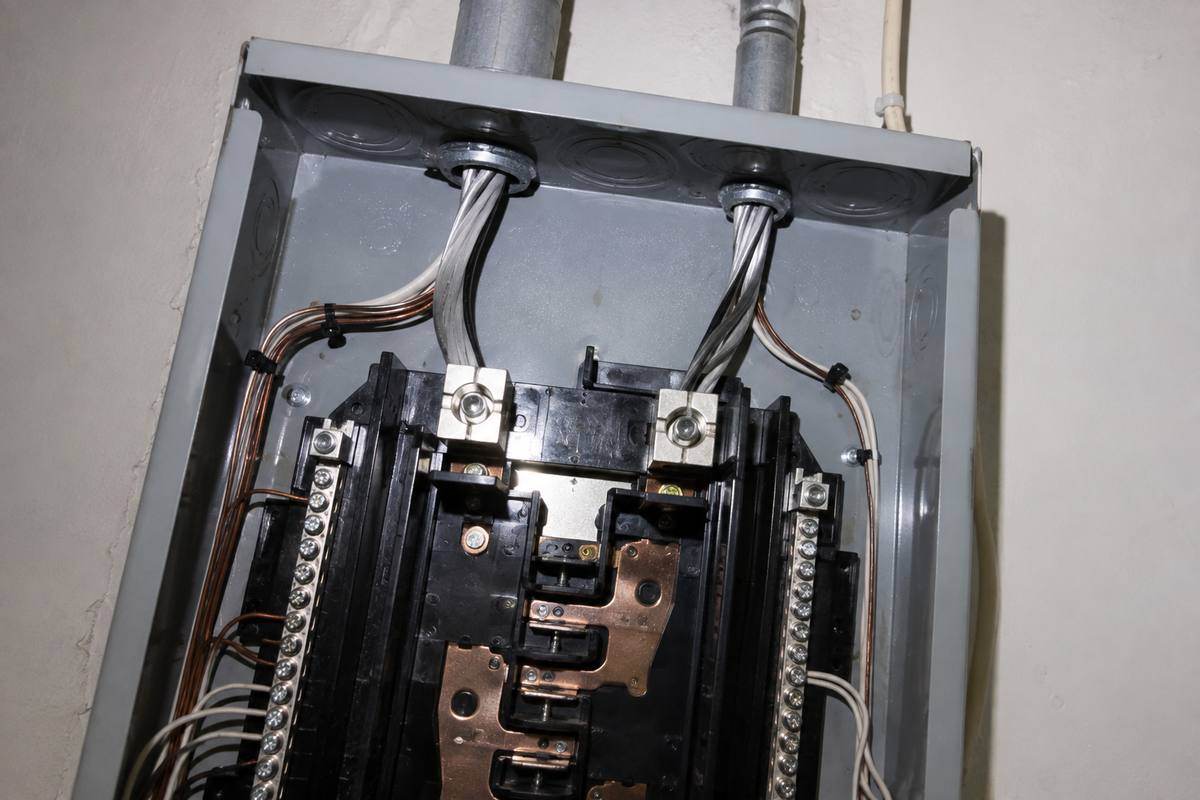
The point where a service conductor lands on the lug at the top of the panel. Torque relaxes, aluminum conductors creep and oxidize, heat cycling loosens the joint, resistance climbs and eventually the connection stops carrying. This is the classic house-side cause, and it is the one that gets hot before it gets open.
Four candidates, on a symptom that could theoretically involve anything. That is why an accurate description on the phone is worth so much here: it is one of the few electrical complaints where the answer is usually found rather than hunted for. How diagnostic work is priced →
Reading the maker’s name and the main breaker rating off the panel door is a reasonable thing to do, and this site recommends it elsewhere. This symptom is the exception, for a specific reason rather than general caution.
Three of the four candidates above sit at or ahead of the main breaker. The main lugs and the service conductors landed on them stay energized when the main breaker is switched off, because they are upstream of it. No switch inside the house de-energizes them; only the utility can. Removing the inner cover to look at the exact area this symptom implicates puts hands beside conductors that cannot be turned off from inside the property, at full service current, with no overcurrent device between them and the transformer. Read the door, close it, and describe the pattern to someone whose license covers going further.
In deregulated Texas the company that bills you sells energy and nothing else. CenterPoint owns the meter and maintains the facilities at the point of delivery regardless of which retail provider is on the bill — its own tariff says residential meters shall be company-owned — and CenterPoint’s tariff lists Fort Bend among the twelve counties in its certificated service area, with a Fort Bend service operation run out of Rosenberg, Richmond and Needville.
So the sequence is: check the street, check whether an area outage is posted, then decide. Evidence pointing upstream of the meter — neighbors affected, a recent storm, a visible problem at the pole or the span — means report it to CenterPoint and let the utility work its own side. Evidence confined to your property, with every other house normal, points at the service equipment and belongs to a licensed electrician. Getting that order right saves a wasted trip charge one way and a wasted day the other. If this began the moment power came back after a storm, the sequencing differs again: partial power after an outage →
Because 240-volt appliances need both legs and 120-volt circuits need only one. The range, dryer, water heater and condenser all draw across the pair, so losing one stops them together while lamps on the surviving leg carry on. That combination is close to a signature.
No. The outer door is fine; the inner cover is not, because the main lugs and service conductors behind it stay energized with the main breaker off and nothing inside the house can de-energize them. That is precisely the area this symptom implicates.
Check the neighbors. If the street is affected or an area outage is posted, report it to CenterPoint. If every other house is normal and only yours is half dark, the service equipment on the property is the likelier place and a licensed electrician is the right first call.
Treat it as urgent. A leg is usually lost at a connection that has degraded, and degraded connections under load make heat. Motors humming without starting, lights shifting brightness, or any warmth, buzzing or smell at the meter or panel enclosure moves it from urgent to immediate.
Which rooms are dead, whether the range and dryer went with them, and whether the neighbors are fine. Three answers, and the search is already narrow.
Call (346) 857-1116 Request a Quote Fort Bend